
LinkedIn Outreach Automation Mistakes You're Probably Making (And How LinkAngler Fixes Them)
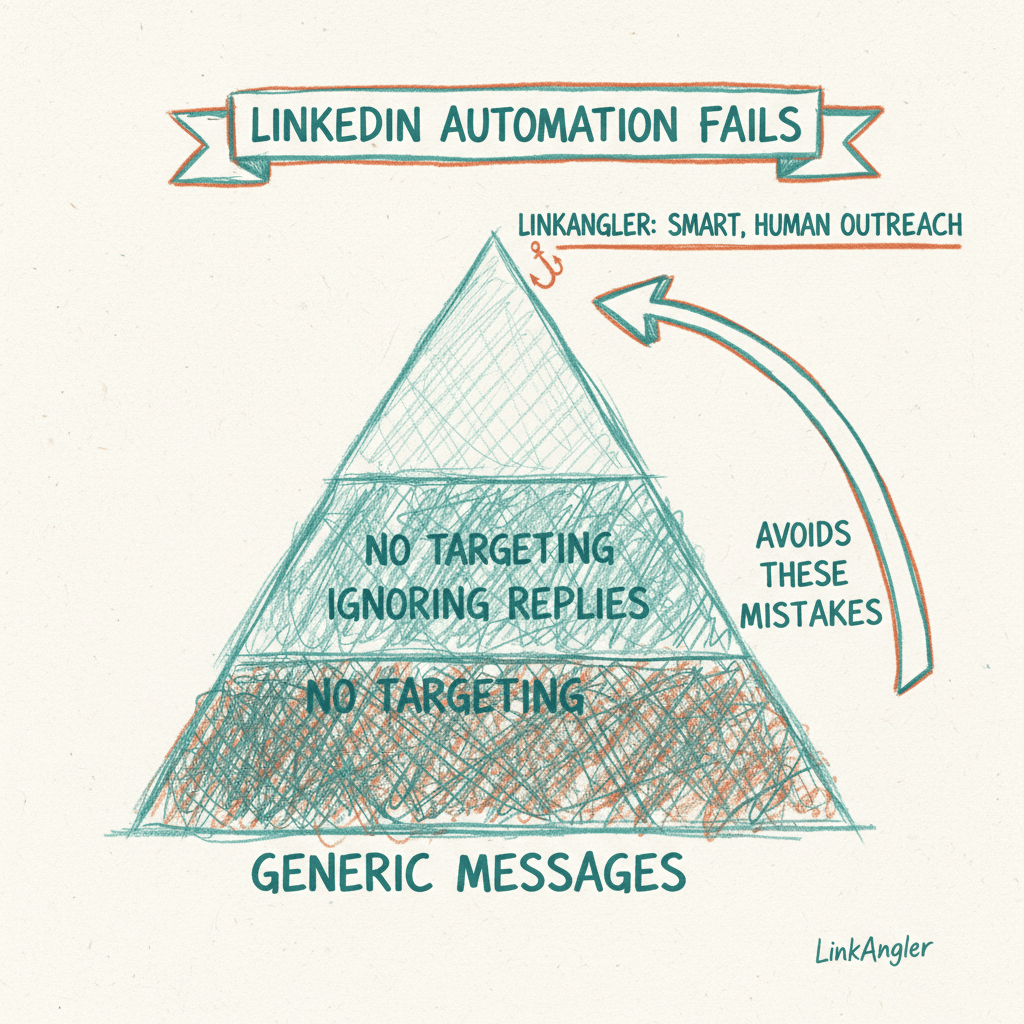
LinkedIn outreach automation has a reputation problem. And honestly? It's earned. Scroll through any LinkedIn feed and you'll find people complaining about robotic connection requests, spammy follow-up messages, and DMs that clearly weren't written by a human being who read your profile.
But here's the thing — the tool isn't usually the problem. The strategy is.
Bad automation gives all automation a bad name. Meanwhile, people running thoughtful, well-structured outreach campaigns are quietly booking meetings, closing deals, and growing their networks at scale. The difference between those two camps comes down to a handful of mistakes that are surprisingly common and surprisingly fixable.
Let's walk through the biggest ones.
Mistake #1: Sending the Same Message to Everyone
This is the cardinal sin of LinkedIn outreach automation, and it's responsible for a huge percentage of ignored (or reported) messages.
It usually looks like this: someone builds a list of 500 prospects, writes one generic message, and blasts it to everyone. The message says something like "Hi [First Name], I came across your profile and thought we'd be great to connect!" — and that's it. No context, no relevance, no reason for the recipient to care.
The problem isn't personalization for the sake of being nice. It's that generic messages signal to recipients that you haven't thought about them at all. They're immediately disposable.
What to do instead
Real personalization doesn't mean writing a custom essay for every prospect. It means identifying the relevant variables that make a message feel targeted:
- Industry-specific language — speak to a SaaS founder differently than a manufacturing executive
- Role-based pain points — a VP of Sales has different concerns than a Head of HR
- Recent activity — referencing a post they made, a job change, or a company milestone
Good automation tools let you build these variations into templates with dynamic fields and segment-based messaging. In LinkAngler, you can create separate message sequences for different audience segments, so your SaaS founder and your manufacturing exec are getting totally different messages — even if they're both in the same campaign.
Mistake #2: Skipping the Warm-Up Phase
A lot of people start their LinkedIn outreach automation campaigns by going straight to the pitch. Connection request accepted → immediate sales message → confused or annoyed prospect.
Think about how that feels from the other side. You've just connected with someone you don't know, and their first message is a product demo request. Even if what they're offering is genuinely useful, the timing creates friction.
The warm-up phase exists for a reason. It's the difference between cold and lukewarm — and that temperature difference dramatically changes response rates.
Building a proper sequence
A solid outreach sequence might look like this:
- Connection request — short, personalized note (or no note, depending on context)
- Welcome message — a brief, friendly message after they accept. No pitch.
- Value message — share something genuinely useful: an article, an insight, a question relevant to their work
- Soft ask — only now do you introduce what you do and whether there's a fit
- Follow-up — one or two gentle nudges if there's no response
Most people skip steps 2 and 3 entirely and jump straight to step 4. That's why their campaigns feel pushy.
Spacing matters too. Don't send message 2 thirty seconds after someone accepts your connection. Let it breathe — a day or two at minimum. This is where automation sequencing tools earn their keep. LinkAngler lets you set timing intervals between each message in a sequence, so the pacing feels natural rather than automated.
Mistake #3: Ignoring Campaign Data Until It's Too Late
You launch a campaign, let it run for three weeks, get a 2% response rate, and wonder what went wrong. The postmortem happens after the damage is done.
This is one of the most common failures in LinkedIn outreach automation — treating campaigns as "set it and forget it" when they should be treated as experiments.
Every campaign is a hypothesis. You're testing whether a particular message, targeting a particular audience, at a particular time, generates engagement. If you're not checking the data regularly, you're flying blind.
What metrics actually matter
Here's what to track, and what each metric tells you:
- Connection acceptance rate — if this is low, your connection request message (or your profile) isn't compelling enough
- Reply rate — if you're getting connections but no replies, your first message isn't landing
- Positive reply rate — are people replying with interest, or just asking to be removed?
- Conversion rate — of all the conversations you started, how many turned into meetings or desired outcomes?
Each of these metrics points to a different lever to pull. Low acceptance rate? Fix your opening message or your profile headline. Low reply rate? Rework your first touchpoint. Low positive reply rate? Your targeting might be off — you're reaching people who aren't a fit.
The goal is to catch problems early, iterate on messaging, and improve. Not to run the same campaign six times and wonder why the results don't change.
Mistake #4: Targeting the Wrong People (Confidently)
Automation makes it very easy to reach a lot of people very quickly. That's also what makes bad targeting so costly — you can waste months of effort talking to people who will never buy from you, engage with your content, or add value to your network.
A smaller, well-targeted list will outperform a large, generic one every time.
This is where a lot of people go wrong in their LinkedIn search filters. They set broad parameters — a job title, a country, maybe an industry — and assume that's enough. But within "Marketing Manager in the United States" there's a massive range of company sizes, budget authorities, tech stacks, and use cases.
Sharpening your targeting
Before building your outreach list, get specific about:
- Company size — who can actually afford or benefit from what you offer?
- Seniority level — are you trying to reach decision-makers or influencers?
- Industry verticals — which sectors have the highest fit for your solution?
- Growth signals — companies that just raised funding, expanded headcount, or launched new products are often in buying mode
The more specific you get on the front end, the better your campaigns will perform. It also makes personalization easier, because you're writing to a narrower, more homogenous audience.
Mistake #5: Writing Follow-Ups That Feel Like Nagging
Follow-ups are essential. Most conversations don't happen on the first message. But there's a fine line between a helpful nudge and a message that makes someone feel pestered.
Bad follow-ups look like:
- "Just checking in..."
- "Did you see my last message?"
- "I wanted to circle back on this."
These add zero value and telegraph that you're just bumping your message to the top of their inbox. They work occasionally, but they're annoying — and they don't give the prospect any new reason to engage.
Good follow-ups add something new to the conversation.
How to write follow-ups that actually work
Each follow-up should introduce a fresh angle:
- Follow-up 1: A piece of content — an article, a case study, or a data point relevant to their role
- Follow-up 2: A different framing of your original value proposition, or a question that invites a response
- Follow-up 3 (breakup message): A respectful, low-pressure close — something like "No worries if the timing isn't right — happy to reconnect down the road"
Breakup messages often get the highest response rates of the entire sequence, because they remove pressure and signal that you're a real person who respects their time.
Mistake #6: Neglecting Your LinkedIn Profile
This one catches people off guard. You can have the best LinkedIn outreach automation campaign in the world, but if someone clicks on your profile and it's half-empty or unconvincing, you've lost them.
Your profile is your landing page. It's where people go to decide whether they want to engage with you.
Profile essentials for outreach campaigns
Before running any campaign, audit these:
- Headline — does it clearly communicate who you help and how? Not just your job title.
- Profile photo — professional, clear, approachable
- About section — written in first person, focused on value you provide, not a list of credentials
- Featured section — use this to showcase relevant content, case studies, or social proof
- Recent activity — are you posting or engaging on LinkedIn? An active profile looks credible
If someone accepts your connection request and lands on a profile that looks abandoned or generic, the conversation is probably over before it started.
Mistake #7: Running Too Many Campaigns at Once Without a System
When LinkedIn outreach automation goes well, it's tempting to scale quickly — more campaigns, more segments, more messages. But without a system to manage it all, things break down fast.
You end up with the same prospect in multiple campaigns, contradictory messages going out to the same person, or reply threads falling through the cracks because you don't have a clear process for handling responses.
Building a system that scales
A few things that help:
- Deduplicate your lists before launching any new campaign
- Tag and segment prospects based on where they are in the conversation
- Define clear handoff points — when does a LinkedIn conversation move to email, a call, or your CRM?
- Set aside dedicated time to handle replies — automation handles the outreach, but humans handle the conversations
LinkAngler's campaign management dashboard makes it easier to keep track of multiple campaigns simultaneously, see who's responded, and avoid the awkward situation of reaching out to someone who already said no. Having that visibility in one place is genuinely helpful when you're running outreach at any real volume.
Putting It All Together
LinkedIn outreach automation done well is a force multiplier. It lets you reach more of the right people, with better-timed and more relevant messages, without spending your entire day in your inbox.
But it doesn't happen automatically (pun intended). The campaigns that work are built on solid fundamentals:
- Specific, well-researched targeting
- Personalized, segmented messaging
- A proper multi-step sequence with breathing room
- Regular performance reviews and iteration
- Follow-ups that add value instead of just creating noise
- A LinkedIn profile that earns trust at a glance
Most failed campaigns aren't failing because automation is the wrong approach. They're failing because one or more of these fundamentals is broken.
Fix the fundamentals, use a tool that gives you flexibility rather than forcing you into rigid workflows, and treat every campaign like an experiment worth learning from. Do that consistently, and LinkedIn outreach automation stops feeling like a gamble and starts feeling like a repeatable system.
That's when things get interesting.