
Free Your Week: LinkAngler's Approach to Automating LinkedIn Outreach for More Meetings
When I started LinkAngler, it wasn't because I loved building software. Transparently, it was because I was thoroughly fed up. My previous gig, a decade in data and market intelligence, meant I knew the value of finding the right people. But the process of actually reaching them was a colossal time sink. I was shelling out over 400 quid a month on tools like PhantomBuster and Dripify. They promised automation, but what I got was capped limits, endless manual checks, and a whole lot of frustration.
It felt like I was spending ten hours a week just to get a few conversations started. That's ten hours I could have been surfing, or building, or doing anything else productive. That annoyance birthed LinkAngler. My goal was simple: take anything a business does that eats ten hours a week, and get it done in the time it takes to press a button. That's the "10 hours to 10 seconds" philosophy, and it's built into every part of LinkAngler. We don't just automate tasks; we automate outcomes. The outcome we're focused on for you is booked sales calls, consistently, with less fuss.
The Invisible Cost of "Manual" LinkedIn Outreach
Most people don't track the actual cost of their LinkedIn outreach. They see the hourly rate they pay staff, or their own time, and assume that's it. But the real cost is far higher. It's the cost of opportunity. Every hour spent manually sifting through profiles, crafting connection requests, and chasing replies is an hour not spent closing deals, improving your product, or strategising for growth.
Consider this: if you manually identify ten ideal prospects a day, write ten personalised messages, and follow up with twenty people, how long does that take you? An hour? Two? Let's say two hours. Five days a week, that's ten hours. What's your time worth an hour? Let's be conservative and say £50. That's £500 a week. £2,000 a month. Just for the busywork.
Now, what if that effort only yields one booked call a week? And what if that booked call has a 25% close rate, bringing in a £1,000 per month client? So, you spend £2,000 a month in "labour" to get one £1,000 per month client. That's not a great return.
This isn't about selling you on software. It's about showing you where your time, and money, is truly going. The goal is to shift that equation. To reduce the "labour" cost dramatically, while increasing the number of booked calls. This is where LinkAngler comes in, letting you automate LinkedIn outreach effectively.
Moving Beyond "Spray and Pray" with Intentional Automation
Many people hear "automation" and think "spam." They picture generic messages, mass outreach, and instantly hitting the LinkedIn algorithm's spam filters. I wouldn't build something that did that. It's bad for business, and it's bad for your reputation.
The point of automation isn't to send more messages. It's to send better messages, to the right people, at scale. It's about giving you the ability to maintain a genuinely personal touch, even when you're reaching out to hundreds of prospects.
Precision Targeting: Finding Your Perfect Prospect
Before you send a single message, you need to know who you're talking to. This sounds obvious, but many people skip this step or do it poorly. They rely on broad job titles or industry segments. That's like trying to hit a bullseye with a shotgun from 100 yards.
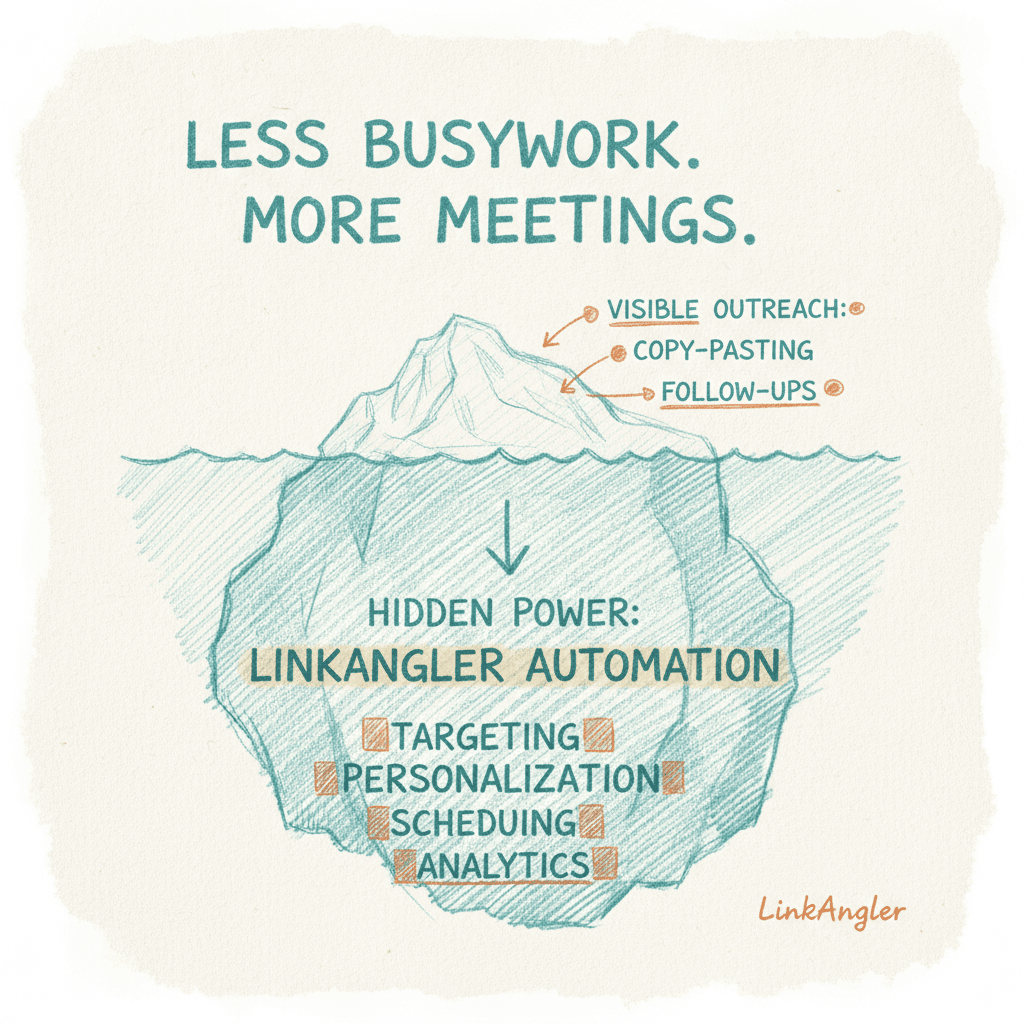
LinkAngler allows for highly specific targeting. We use AI to help you find your ideal customers based on a whole host of criteria: company size, role, location, even technologies they use or specific keywords in their profiles. This isn't just about filtering. It's about building a robust Ideal Customer Profile (ICP) that informs every aspect of your outreach.
For example, instead of targeting "marketing managers," you might target "Head of Demand Generation at SaaS companies in the UK with between 50-200 employees, using HubSpot, who have recently posted about growth strategy." That's a much smaller, but infinitely more valuable, pool. The more precise your targeting, the higher your conversion rates will be, because your message will resonate more deeply. This is the foundation of effective automated LinkedIn outreach.
Personalisation That Doesn't Sound Like a Robot
Once you have your ideal prospects, the next challenge is crafting messages that don't sound automated. This is where most tools fall down. They offer basic placeholders, which everyone can spot a mile away.
I refuse to allow truly generic messages. Our system uses advanced AI to craft genuinely personal messages. It pulls specific details from a prospect's profile, recent activity, or company news. It considers your unique value proposition and aligns it with their likely pain points.
But here's the kicker: nothing goes out without a human quality gate. I believe strongly that true connection requires human oversight. The AI drafts the message, but you have the final say. You can review and approve every message before it sends, ensuring it sounds exactly like you. This means your messages are genuinely personal, not just templated. The result? More replies, and better quality replies. These personalised messages mean your emails actually land in the inbox, so more of them turn into replies and booked calls.
The Art of the Follow-Up, Fully Automated
The vast majority of sales happen after the first touch. Yet, most people give up after one or two attempts. Why? Because manual follow-up is tedious, time-consuming, and easy to forget.
This is where automation becomes truly powerful. LinkAngler automates your entire follow-up sequence. This isn't just a generic "bumping this up" message. It's a sequence of value-driven touchpoints, spread out over weeks or even months.
We test every automation on my own accounts first. I've found that a well-crafted follow-up sequence, delivering genuine value, is key. This might involve sharing a relevant article you've written (easily done with our Article Library), asking a thought-provoking question, or offering a useful resource. The system tracks engagement and adjusts. If someone clicks a link, the next message might be tailored to that interest. If they don't respond after a few weeks, the system can re-engage with a fresh angle, ensuring that cold leads come back with fresh angles.
This means you are consistently staying top-of-mind with your ideal prospects, without lifting a finger after the initial setup. Imagine waking up to interested replies from prospects you connected with weeks ago, all thanks to an automated sequence designed to deliver genuine value.
Why a Full Calendar Doesn't Mean Full-Time Effort
The ultimate goal of all this isn't just more replies. It's more booked calls in your diary. That's the real ROI.
LinkAngler takes interested replies and turns them into meetings. When a prospect indicates interest, the system can automatically send them a booking link to your calendar. This happens while they are still keen, eliminating the lag time that often kills momentum in manual outreach. You wake up to meetings, not a backlog of messages to chase.
Safe Scaling: Protecting Your Reputation
A common fear with automated outreach is damaging your sender reputation or getting flagged by LinkedIn. This is a legitimate concern, and it's why LinkAngler is built with safety features at its core.
We use strategies like inbox rotation and warm-up periods for email accounts. This protects your sender reputation, so volume goes up without deliverability going down. It's about scaling intelligently, not recklessly. We also have "quiet hours" settings to ensure messages aren't sent at odd times, making the outreach feel more natural.
My philosophy here is clear: if it doesn't create a real result without risk, I kill it. That's why I refuse to fully automate things like AI comments on other people's posts. They rarely sound human, and they can damage your credibility. Human review gates stay for critical interactions.
Beyond Outreach: The 10 Hours to 10 Seconds Philosophy
While LinkedIn outreach is a massive area for automation, the "10 hours to 10 seconds" idea extends far beyond it. I built LinkAngler to free up time across the entire business.
Think about other areas where you, or your team, spend hours on repetitive tasks:
- Client Intake: From initial enquiry to a signed proposal and onboarding, there are countless steps. How many hours a month does this consume? We have a guide on automating client intake so you can streamline the process from discovery call to plan.
- Session Notes: Coaches, consultants, and service providers spend hours summarising sessions. Imagine those notes writing themselves, ready for review.
- Content Creation: Repurposing content from a single voice note into multiple formats. A week of content from a single voice note? Absolutely. My free guide shows you how to turn one voice note into a week of presence.
- Client Book Sweeps: Regularly checking your entire client base for what's due, who needs a touchpoint, or identifying upsell opportunities. This used to be a full-day task for many.
These are all areas where the right automation can give you hours back every week. We even provide free build-it-yourself guides for all four of these scenarios, available at /downloads. They include the exact prompts to build the automation yourself, no strings attached.
The ROI of Time: What an Extra 10 Hours is Really Worth
Let's revisit that initial calculation. If you were spending two hours a day, ten hours a week, on manual outreach, that's £2,000 a month in "labour" at £50 an hour.
What if you could cut that to two hours a week? That's an 80% reduction in time spent on that specific task. You've just reclaimed eight hours a week. What could you do with those eight hours?
- More Strategy: Instead of executing, you're planning.
- More Deep Work: Focusing on high-value tasks that only you can do.
- More Family Time: Reclaiming your evenings or weekends.
- More Surfing: (That's my personal favourite, living here in Sri Lanka.)
But it's not just about saving time. It's about increasing the output of that time. When you automate LinkedIn outreach effectively with LinkAngler, you're not just saving ten hours; you're often getting two, three, or even five times the number of booked calls from the fraction of the time you now spend.
Let's say LinkAngler helps you book three calls a week instead of one, for a fraction of the time. If each booked call still has a 25% close rate, and each client is worth £1,000 per month, you've now increased your new client acquisition by £2,000 per month. That's £24,000 a year in new revenue, for significantly less effort than you were putting in before.
Suddenly, the cost of automation becomes negligible. If just one booked call becomes a 1,000-pound-plus per month client, the spend has paid for itself many times over, often 10x+. That's the power of focusing on outcomes, not just features.
Practical Steps to Automate LinkedIn Outreach and Book More Calls
Ready to take control of your calendar and your time? Here's how to start thinking about automating your LinkedIn outreach.
1. Define Your Ideal Prospect (Again, But Better)
Don't skim this. Go deeper than you ever have. Use our AI-powered lead scoring tools to identify not just who they are, but what their pain points are, what content they engage with, and what motivates them. What problems do you solve for them? Write it down. The more specific you are, the better your automation will perform.
2. Audit Your Current Outreach Process
Grab a stopwatch. Seriously. Map out every single step you currently take to find a lead, connect, message, and follow up. Time each step. Now, add up those hours. Use our free time audit calculator to see the true cost of your current process. This will be an eye-opener.
3. Craft a "Give First" Initial Message
Your first touch should never be a hard sell. Think about what value you can offer. An insightful observation about their industry? A genuinely helpful resource (perhaps an article from your Article Library)? A thought-provoking question related to their role? The goal is to start a conversation, not to close a deal on the first message. Our system helps you create these engaging messages, ensuring they don't sound like a robot.
4. Build a Value-Driven Follow-Up Sequence
Plan out 3-5 follow-up messages. Each one should offer a different piece of value or a new angle. Think about sharing relevant content, case studies, or asking questions that encourage a response. Ensure these are spread out over several days or weeks. With LinkAngler, this sequence will run on autopilot, keeping you visible without you having to remember to send each message.
5. Set Up Your Booking Flow
Once someone shows interest, make it as easy as possible for them to book a call. Integrate your calendar. LinkAngler's hot lead detection ensures that interested replies get a booking link while the prospect is still keen, so you wake up to meetings, not a backlog. Reduce friction.
6. Review and Refine Regularly
Automation isn't a "set it and forget it" thing entirely. You need to review your results. What messages are getting the best response? Which targeting criteria are yielding the highest quality leads? Our analytics give you clear insights. Then, iterate. Auto-improves over time, meaning the pipeline keeps growing. This continuous improvement ensures your outreach campaigns are always optimising for more booked calls.
Conclusion
Automating LinkedIn outreach isn't about replacing human connection; it's about amplifying it. It's about taking the tedious, repetitive tasks that eat up your day and handing them over to an intelligent system. This frees you to focus on the high-value activities: building relationships, having meaningful conversations, and closing deals.
My goal with LinkAngler was always to create a business that worked for me, not the other way around. Living in Sri Lanka, surfing most mornings, and building from 9 till 5 is possible because I built a system that handles the busywork. I built it so others could have that freedom too.
If you're tired of spending ten hours a week on manual outreach, only to see a trickle of booked calls, it's time to rethink your approach. Imagine what you could achieve with those ten hours back, and a calendar that fills itself with qualified meetings. That's the promise of LinkAngler. It's not just software; it's your pipeline, on autopilot. You can learn more about how it works and what it delivers on our how it works page.