
Manual LinkedIn Outreach vs. Automation: Why LinkAngler Changes the Math
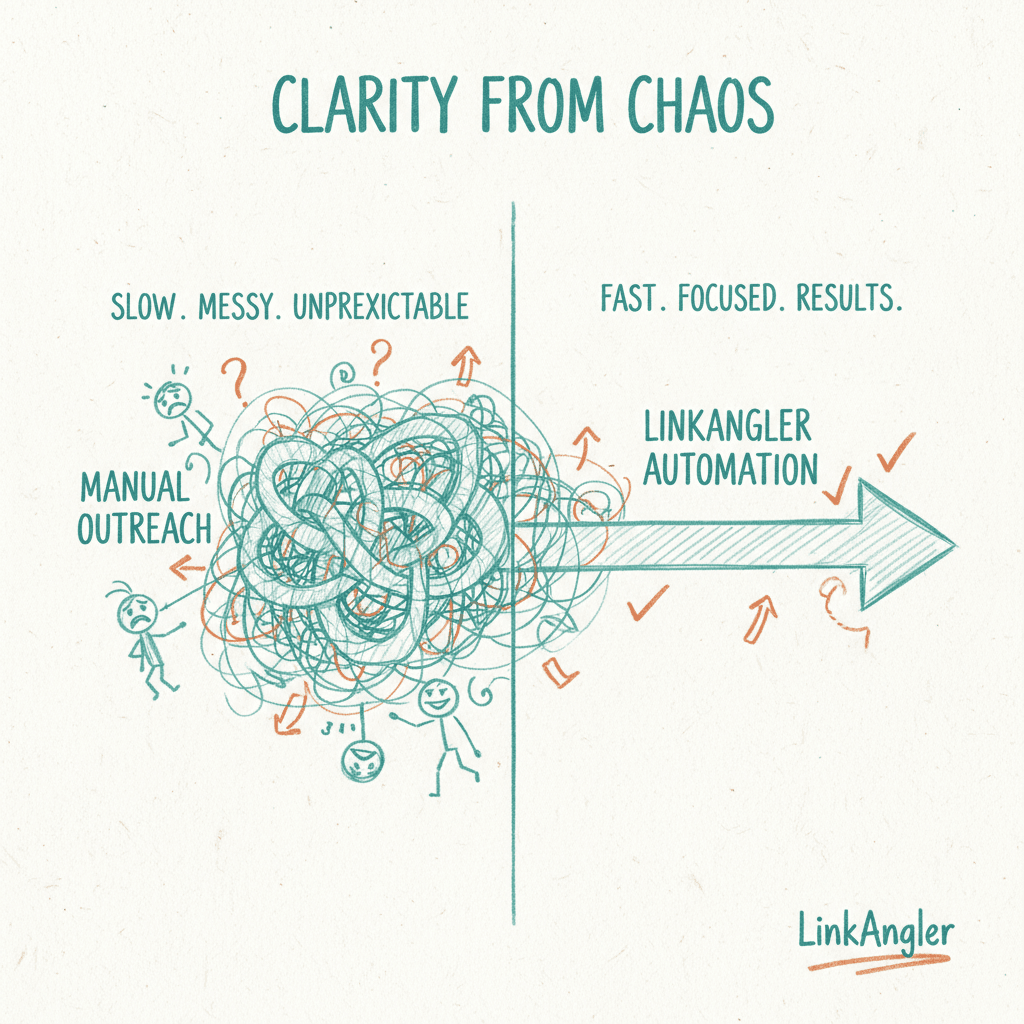
If you've spent any real time trying to grow your LinkedIn network or generate leads through the platform, you've probably had the internal debate: Should I be doing this by hand, or is it time to bring in a LinkedIn automation tool?
It's a fair question, and honestly, the answer isn't as black-and-white as most people make it out to be. Manual outreach has genuine strengths. Automation has genuine strengths. But when you put them side by side at scale — and look at what your time is actually worth — the math starts to tell a pretty clear story.
Let's break it down properly.
The Case for Manual Outreach (It's Not Nothing)
Before we talk automation, let's give manual outreach its due credit. Because if you go into this thinking "manual = bad," you'll end up automating things that shouldn't be automated, and your results will suffer for it.
Manual outreach genuinely shines when:
- You're targeting a handful of ultra-high-value prospects (think: C-suite at a company you've been chasing for a year)
- You need to reference something highly specific — a recent post they wrote, a mutual connection's recommendation, a company announcement
- You're in a relationship-intensive industry where people can smell a template from a mile away
- You're testing a brand new message angle before scaling it
In these cases, the human touch matters. A well-crafted, clearly personal message to the right person can open doors that no automated sequence would.
So manual outreach isn't dead. It's just limited.
Where Manual Outreach Falls Apart
Here's the problem: most people aren't sending 10 carefully crafted messages a week to 10 dream clients. They're trying to build a pipeline. They're trying to stay visible, nurture relationships at scale, and consistently bring new people into their world.
And that's where manual outreach starts to crack.
The Time Math Doesn't Work
Let's get concrete. Say you want to reach 100 qualified prospects per week. A thoughtful manual message — researching the person, writing something personalized, sending the connection request, following up — takes somewhere between 5 and 15 minutes per person.
At the conservative end, that's over 8 hours per week just on outreach. That's a full workday. Every week. Just for LinkedIn messages.
And that assumes you're in a rhythm. Add in context-switching, LinkedIn's clunky interface, forgetting who you've already messaged, and tracking follow-ups in a spreadsheet you keep meaning to clean up — and you're looking at more time lost than you probably realize.
Consistency Breaks Down
Manual outreach is also weirdly inconsistent. You have a great Monday, send 20 messages, feel productive. Then a busy stretch hits, and you don't touch LinkedIn for two weeks. Your pipeline goes cold. You start over.
Consistency is what actually drives LinkedIn results — not any individual brilliant message. And humans, being humans, are not naturally consistent when the task is repetitive and the feedback loop is slow.
You Can't Properly A/B Test
When you're writing messages one at a time, from the gut, based on how you're feeling that day, you have no idea what's actually working. Was it the subject line? The ask at the end? The profile you're sending from? The day of the week?
Manual outreach turns what should be a data problem into a vibes problem. And vibes don't scale.
What a LinkedIn Automation Tool Actually Does Well
A good LinkedIn automation tool doesn't replace the human element — it handles the mechanical, repetitive parts so you can focus on the parts that actually require you.
Here's what automation genuinely excels at:
Volume Without Burnout
This is the obvious one. An automation tool can send connection requests, follow-ups, and messages at a scale no human can match without burning out or making careless mistakes. You set the sequence, define the audience, and let it run while you focus on other things.
Enforcing Consistency
Automation doesn't have off days. It doesn't skip follow-up messages because you got distracted. It doesn't forget to check back in with someone who opened your message but didn't reply. It just runs the sequence, on schedule, every time.
This matters more than most people realize. A huge percentage of LinkedIn deals and connections happen in the 3rd or 4th touchpoint — the ones that most people never send manually because they've moved on to something else.
Real A/B Testing
When you're running outreach at scale with an automation tool, you can actually test things systematically. Send version A of a message to 200 people, version B to 200 people, and see which one gets more replies. Do that consistently and you'll improve your messaging far faster than any intuition-based manual approach.
Audience Segmentation at Scale
Good automation tools let you build campaigns based on specific audience segments — industry, job title, geography, company size — and deliver different messages to each. Trying to do that manually is a nightmare. With automation, it's just a filter.
The Hybrid Approach: Where the Real Magic Happens
Here's the take that most "automation vs. manual" articles miss: the best LinkedIn outreach strategy isn't one or the other. It's both, used strategically.
Use automation for:
- Initial connection requests at scale
- First and second follow-up messages
- Nurture sequences to stay on people's radar
- Re-engagement campaigns for cold connections
- Testing message variations
Use manual outreach for:
- High-value, highly specific prospects
- Responding to replies (always respond manually — please)
- Relationship building with people already in your network
- Anything requiring true personalization that a template can't capture
The automation handles the top of the funnel and the follow-up engine. The human handles the conversations.
This is, incidentally, exactly how LinkAngler is designed to work. The platform runs your campaigns in the background — connection requests, follow-up sequences, multi-step outreach — without the artificial caps that most tools impose. So if you're trying to reach 500 people this week instead of 50, you're not hitting a wall. And when someone replies, you step in and have a real conversation.
A Real-World Scenario: Selling B2B Services
Let's make this concrete. Say you're a marketing consultant selling services to SaaS founders. Your ideal client is a founder or head of marketing at a Series A or B company.
Without automation: You spend Sunday night making a list of 20 people to reach out to this week. You manually write each message, send connection requests, and remind yourself to follow up in a few days. By Wednesday you've forgotten half of them. By Friday you've sent maybe 15 messages total, followed up with 4, and you have 2 conversations going.
With a LinkedIn automation tool: You build a campaign targeting Series A/B SaaS companies, filtered by founder and marketing leader job titles. You write 3 versions of a connection message to test. You set up a 3-step follow-up sequence. You hit go.
Over the same week, you've reached 150 people. Your automation sends the follow-ups. You wake up to 8 replies in your inbox and spend an hour having real, genuine conversations with actual interested prospects.
Same effort from you. Very different results.
Common Objections to LinkedIn Automation (And Honest Answers)
"Won't people know it's automated?"
If you're sending robotic, impersonal messages — yeah, people can tell. But that's a writing problem, not an automation problem. A well-written, relevant message doesn't feel automated. The goal is to write messages that would feel natural even if you'd sent them manually.
"Isn't automation against LinkedIn's rules?"
LinkedIn doesn't love third-party tools, and that's worth acknowledging. The risk largely comes from using tools that behave unnaturally — sending hundreds of messages in minutes, scraping data in ways that spike suspicious activity, or using browser-based tools that LinkedIn can detect easily. A well-built LinkedIn automation tool that respects pacing and mimics natural usage patterns carries far less risk than people often assume. As always, use your judgment and don't do anything that feels obviously reckless.
"I tried automation before and it didn't work"
This is usually a message quality problem or an audience targeting problem — not an automation problem. Automation amplifies your strategy. If the strategy is bad (wrong audience, weak message, no follow-up plan), automation will just amplify that faster. The fix is to nail the fundamentals first, then scale them.
How to Actually Get Started with LinkedIn Automation
If you're ready to stop doing this entirely by hand, here's a practical starting point:
-
Define your target audience clearly. Job title, industry, company size, geography. The more specific, the better your results.
-
Write 2-3 connection message variants. Keep them short, relevant, and low-friction. No pitching in the first message. Just a genuine reason to connect.
-
Build a follow-up sequence. 2-3 messages, spaced out over 1-2 weeks. Each one adds value or opens a door — doesn't just bump the previous message.
-
Set a realistic daily pace. Even with automation, don't go from zero to 200 connection requests a day overnight. Build up gradually and keep behavior patterns natural.
-
Monitor replies personally. When someone responds, you take it from there. The automation got them to the door; you close the conversation.
-
Review results weekly. Look at connection acceptance rates and reply rates. If something's not working, tweak the message or the audience — not the tool.
LinkAngler makes this process pretty straightforward — you can run multiple campaigns simultaneously, test different messages, and adjust without starting from scratch every time. The lack of artificial caps means you can actually operate at the pace your business needs, not the pace the tool arbitrarily decides for you.
The Bottom Line
Manual LinkedIn outreach is valuable. But it's not scalable, it's inconsistent, and it eats time that most people don't have.
A LinkedIn automation tool doesn't make your outreach less human — it makes it more consistent, more testable, and more scalable so that the human parts (the replies, the conversations, the relationships) actually get the attention they deserve.
The people who win on LinkedIn aren't the ones who write the most beautiful individual messages. They're the ones who build a system — a combination of smart automation and genuine human follow-through — and run it consistently over months.
Start there. Build the system. Let automation do the heavy lifting. Show up for the conversations.
That's the math that actually works.