
One Voice Note, a Week of Content: The Free LinkAngler Guide
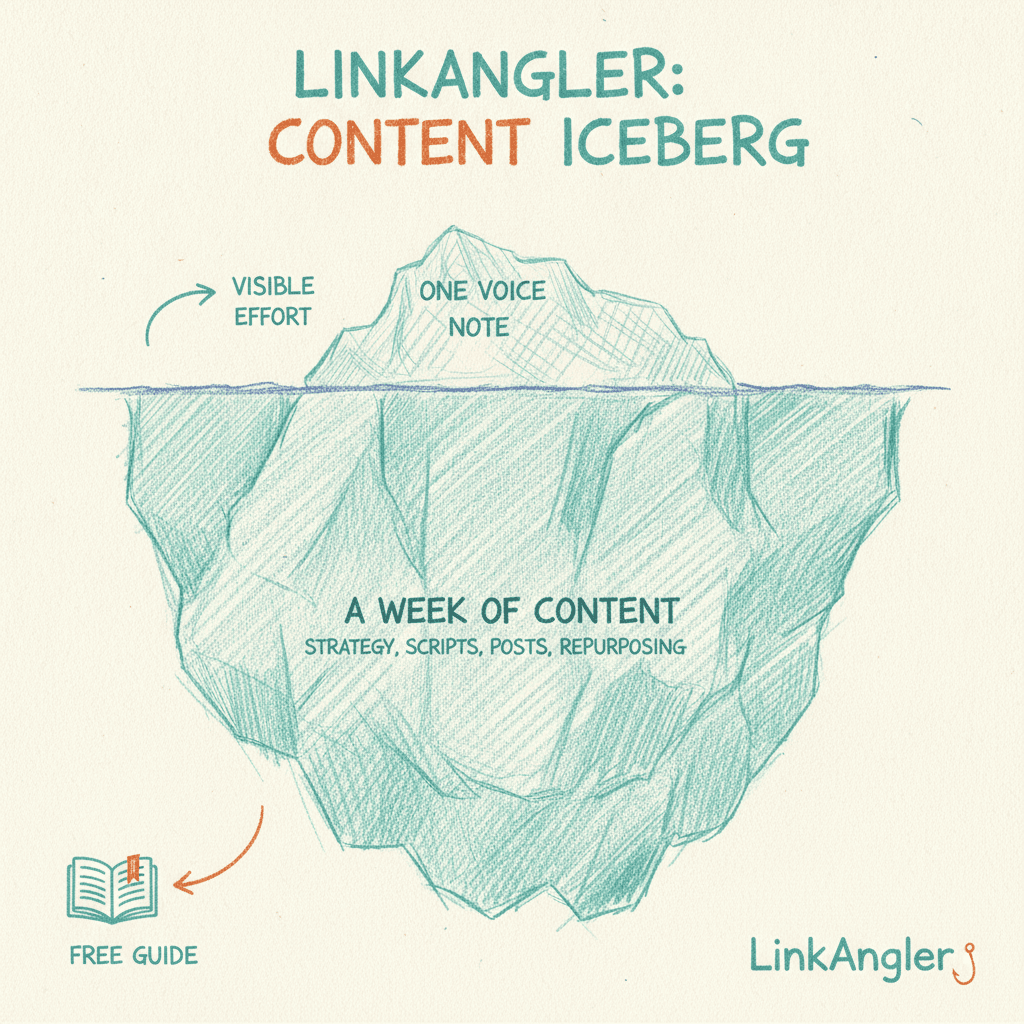
You do not have a content problem. You have a repetition problem.
You already know what you want to say. You say it on calls all day. The problem is sitting down afterwards and turning it into posts, again and again, every single week. That is the part that dies first when you get busy, and it is exactly the part a machine should be doing.
I built an automation that fixes this, and I have written the whole thing up as a free guide. Here is what it does and why it works.
The idea: talk once, publish all week
The input is one voice note. You record it on your phone, rambling is fine, and send it over WhatsApp. Two minutes of your actual thinking about your actual clients.
The output is a week of content. A hero post plus four more across different formats: a post, a short video script, a carousel, a poll. Each one drafted in your voice, because the system has learned it from your own past posts, not from a generic template. It even sorts an image, matched from your brand library or generated to fit.
That is the "10 hours to 10 seconds" idea applied to content. The ten hours you were spending drafting, second-guessing and formatting collapses into the time it takes to record a voice note on the walk between meetings.
Why the voice note matters
Written briefs kill good content. By the time you have typed out what you meant, you have flattened it into corporate speak.
A voice note keeps the phrasing you would actually use. The stories come out in the order you would tell them. The system works from that raw material, so the drafts sound like you on a good day, not like a content agency doing an impression of you.
Fresh input matters too. Because you record a new note each week, the content tracks what you are actually seeing in your business right now. It never goes stale the way a bank of evergreen templates does.
The part most people skip: the quality gate
Transparently, raw AI drafts are not good enough to publish. Anyone who tells you otherwise is not reading their own output.
So the system scores every draft against five checks before you ever see it: does it sound like you, is it free of AI cliches, are the claims defensible, is the hook strong, is there a clear call to action. Anything that fails gets revised and rescored, up to three passes.
And then the non-negotiable: nothing posts until you approve it. You get the whole week parked for review, you edit inline, set the posting times, and press approve. The machine does the hours; you keep the judgement. I refuse to build it any other way, because an automatic quality check on every message is the difference between automation that builds your reputation and automation that burns it.
What is in the free guide
I wrote the whole system up as a PDF, and the bit I care about most is on page two: the complete prompt to build it yourself in your own stack. Paste it into Claude Code, swap the named tools for whatever you use, and you have the same machine I run. No gated nonsense, no book-a-call-to-learn-more.
The guide also covers:
- The one-time setup, connecting WhatsApp, transcription and your image sources
- How to record a voice note that produces a great week (this is a skill, and it takes about three goes to learn)
- Every option on the trigger, from copy frameworks to audience targeting
- The approve-and-schedule flow that actually publishes it
You can grab the Content guide free here, on its own or with the other three automation guides.
Where this fits in the bigger picture
Content is one half of showing up on LinkedIn. The other half is outreach, and the same rules apply there: personal beats template, quality gate beats volume, human approval beats full autopilot.
That is the whole LinkAngler approach. AI finds your ideal customers and starts genuinely personal conversations, your best articles get shared with the right prospects at the right moment, and interested replies turn into booked calls while the prospect is still keen. The content system keeps you visible; the outreach system fills the diary. If you want to see what that combination is worth in hours, the time audit calculator will tell you in about a minute.
Start this week
Record one voice note about the question your clients asked you most this month. That is it. That is the whole habit.
Then go and get the guide, build the machine that turns it into a week of content, and spend the hours you get back on the work only you can do. If you get stuck on the build, reply to any email from me and ask.