
One Voice Note, One Week of Presence: Solving the 10-Hour Content Problem
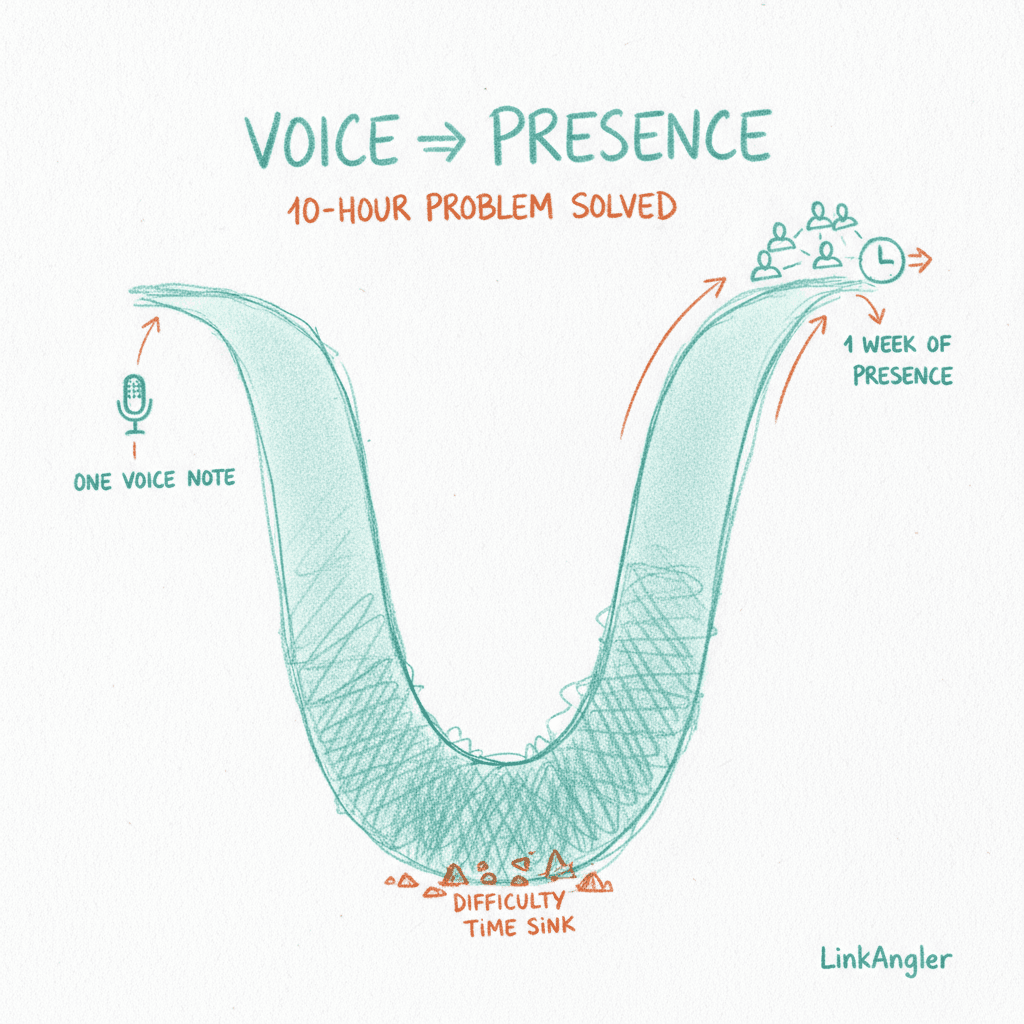
Ask a room of coaches whether consistent content wins clients and every hand goes up. Ask who actually posts consistently and most hands drop.
The gap is not discipline. It is arithmetic. A week of decent content, a few posts, a newsletter, client follow-ups, costs eight to twelve hours. That time comes straight out of client delivery or your evenings, so it is always the first thing to slip.
This problem frustrates me, because I lived it. Before LinkAngler, when I was selling data and market intelligence, I understood the power of showing up. But I also understood the grind of creating. So, when I started LinkAngler, I designed something to get that 10 hours a week down to 10 seconds. Not just for booked calls, but for all the little tasks that eat away at your day. For coaches, that often means content. Everyone knows you need to be visible, you need to share your expertise, and you need to build trust. But the time spent creating content is seen as a tax on your income, or worse, your personal time.
It truly does not have to be that way.
The Intensity Trap: Why Bursts Fail to Build Trust
We have all been there. You get a surge of inspiration, maybe you just finished a brilliant client session, or learned something new at a workshop, and you commit to daily posts for two weeks straight. Your LinkedIn lights up. Your newsletter goes out on time. You feel productive. Then, a new client project lands, a family commitment pops up, or you just get plain tired. The daily posts become weekly, then fortnightly, until a month of silence stretches out.
What happens during that silence?
The algorithm, a cold, indifferent beast, might give you a pass eventually. It might even boost your posts again when you return. Algorithms are built for engagement metrics, not the subtleties of human trust.
Your audience, however, is not as forgiving. The people who are quietly watching, the ones who might become your next client, notice the rhythm. Or the lack of it. Think about your own consumption habits. When you follow someone whose insights you value, and they disappear for a month, what happens? You probably forget about them. Maybe you unfollow. You move on to someone else who is showing up.
Trust is built by rhythm, not volume. It is the steady drip of value, the consistent presence, the predictable insight that tells a prospective client, "This person shows up. This person is reliable. This person might be able to help me." They need to see you reliably before they will reach out about something that matters to them. An inconsistent presence signals an inconsistent business. It creates doubt, not desire.
The content creation process for many coaches is like a feast-or-famine cycle. They produce a lot when they have time, then nothing when client work is heavy. This creates an unhelpful perception. You want to be seen as the steady hand, the consistent expert, the dependable source of insight. Bursts of activity, followed by silence, achieve the opposite. They make your audience question your commitment and consistency. You want to create consistent content for coaches that quietly does its job without demanding all your time.
A Coach's Transformation: From 10 Hours to 10 Seconds
An executive coach I work with faced this exact problem head-on. She's incredibly insightful, brilliant with her clients, and her sessions are packed with actionable wisdom. But turning those hours of deep thought and interaction into consistent LinkedIn posts, newsletter segments, and client follow-up messages was a monumental task. She was burning roughly ten hours a week just on content production. That is ten hours not spent on client delivery, on business development, or simply living her life.
We found a solution that profoundly changed her entire approach. The system starts with a single voice note or, sometimes, a recorded snippet from a call (with client permission, of course, and always safeguarding privacy). Instead of trying to write polished prose from a blank page, she simply talks. She speaks her insights, outlines a client scenario, or expands on a concept, just as she would in a natural conversation.
This spoken content then forms the foundation for a full week of on-brand content. What used to take her eight to twelve dedicated hours of writing, editing, and scheduling now happens in seconds. The fascinating part was not just the time saved, but the quality. Because the content started from her spoken words, it sounded more authentic. It felt more like her, not less. The warmth, the specific turns of phrase, the analogies she uses naturally in conversation, all of it was preserved.
The results were not subtle. Once she achieved reliable, consistent content for coaches, her inbound leads doubled. Her expertise did not change. Her core stories were the same. Her offer remained identical. The only significant variable that moved the needle was her consistent presence. She was showing up reliably, week after week, with valuable insights delivered in her distinct voice. That consistency built trust, and trust led directly to booked calls.
This is a powerful concept for anyone in a consulting or coaching role. Your best content is often already happening in your conversations. It’s what you say when you’re truly engaged, explaining a complex idea, or guiding someone to a breakthrough. The challenge is capturing that natural brilliance and distributing it effectively and consistently.
Why Voice-First Content Resonates
Many coaches and consultants encounter a peculiar problem when they sit down to write. The blank page or screen can be intimidating. The effort to compose something "professional" or "polished" can strip away the very essence of what makes them compelling in person. Their unique warmth, their authentic communication style, their empathetic approach, it all tends to dissipate when they try to force it into written form.
Their true power often resides in how they speak. It is in the natural flow of their thoughts, the subtle pauses for emphasis, the vivid analogies that make complex ideas accessible, and the instinctive way they reframe a client's problem into a clear, actionable insight. Capturing that initial spoken word, exactly as it is uttered, preserves that authenticity. It keeps the "them" in the content.
Think about it:
- Natural Flow: When you speak, your thoughts often flow more freely. You are less likely to get bogged down by perfect grammar or sentence structure in the first draft. This leads to more genuine and less stilted content.
- Authentic Voice: We all have a unique way of speaking. This includes our vocabulary, our phrasing, and even our energy. When you write from scratch, it is easy to adopt a more formal, generic tone. Speaking first ensures your content mirrors the way you actually interact with clients, which is where your connection lies.
- Ease of Creation: Editing something that already exists is far easier than staring at a blank screen, trying to conjure perfection from thin air. You are simply refining, clarifying, and structuring existing thoughts, rather than inventing them from nothing.
- Abundant Material: Coaches and consultants are rich with content. Every single client session, every talk you give, every question a client asks you, every insightful observation you make on the fly, these are all weeks of content waiting to be noticed. The challenge is not a lack of ideas, but a lack of a practical pipeline to turn those ideas into distributed wisdom. You are already saying the things that would inform and attract your ideal clients; you just need to capture them.
This voice-first approach helps bridge the gap between your true expertise (what you say and do with clients) and your outward presence (what you publish). It ensures that your consistent content for coaches reflects your genuine thought leadership. This makes your content not just consistent, but also authentically personal, which builds deeper trust.
The Practical Takeaway: Building Your Content Pipeline
Here's the truth: You do not need more ideas. You are drowning in them. What you need is a practical, low-friction pipeline that transforms the words you already say into the valuable content your future clients are looking for, precisely where they are looking.
Here is how you can start:
- Embrace the Single Voice Note: Commit to recording one voice note a week. This should be your non-negotiable content anchor. Perhaps it is a story from your experience (suitably anonymised, of course), an important insight you shared with a client (again, with scrupulous confidentiality), or a powerful question that helps people reframe a problem. The duration does not matter as much as the depth. Aim for five to ten minutes of you just talking. Imagine you are explaining something critical to your ideal client.
- Focus on Insight, Not Perfection: Do not edit yourself as you speak. Let your thoughts flow. The goal is to capture your natural voice and your unvarnished insight. You can tidy it up later.
- Ruthless Confidentiality: This is paramount. Never, ever, share details that could identify a client or breach their trust. Generalise, anonymise, and focus on the universal principle or lesson rather than the specific case. Your invitation to engage with the content should always be gentle and value-driven, not a hard sell.
- Protect the Rhythm: The power is in the consistency. If one deep insight per week forms the basis for your content, you are creating a predictable rhythm. This rhythm is what builds trust over time. It shows up in your audience's feed reliably, it lands in their inbox when they expect it. Hold this rhythm for a quarter (three months) before you even think about judging the results.
- Expand and Distribute: Once you have your core voice note, you can (or an assistant can) easily transcribe it. This transcription then becomes the raw material for:
- Multiple Social Posts: Pull out key quotes, bullet points, and brief explanations for LinkedIn, Facebook, or Instagram.
- Newsletter Segment: Elaborate on the core idea for your weekly or fortnightly email to subscribers.
- Blog Post Outline: Structure the voice note's content into a more detailed article for your website.
- Client Follow-ups: Adapt parts of the insight into tailored messages for current or prospective clients.
- Video Content: Use the voice note as a script or talking points for a quick video.
This approach ensures that your message is cohesive across platforms, always in your authentic voice, and always rooted in genuine insights. You are not creating more work; you are simply getting more mileage from the work you already do.
Consistency compounds; intensity evaporates. This applies not just to your content, but to your entire business development strategy. Those bursts of frantic activity rarely yield lasting results. What does, however, is a steady, predictable presence that consistently delivers value.
Transparently, this is the pipeline I could not build by hand, which is why it became the content side of LinkAngler. One voice note in, a week of drafts out, and a quality gate on every one of them, because a draft that does not sound like you is worse than no post at all. Nothing publishes until you have read it.
You do not need any of that to start, though. A phone, a transcript and an hour on a Sunday will get you most of the way. The software only matters once the habit is real and the hour has become the thing you resent.
If you want the number before you decide, the free time audit calculator will tell you what your current content routine actually costs you in a year.
The key to consistent content for coaches is not generating more ideas, it is about simplifying the path from your existing wisdom to your audience. Start with the voice note. Protect the rhythm. Watch what happens.