
Raising the Revenue Ceiling in an Accountancy Practice Without Hiring
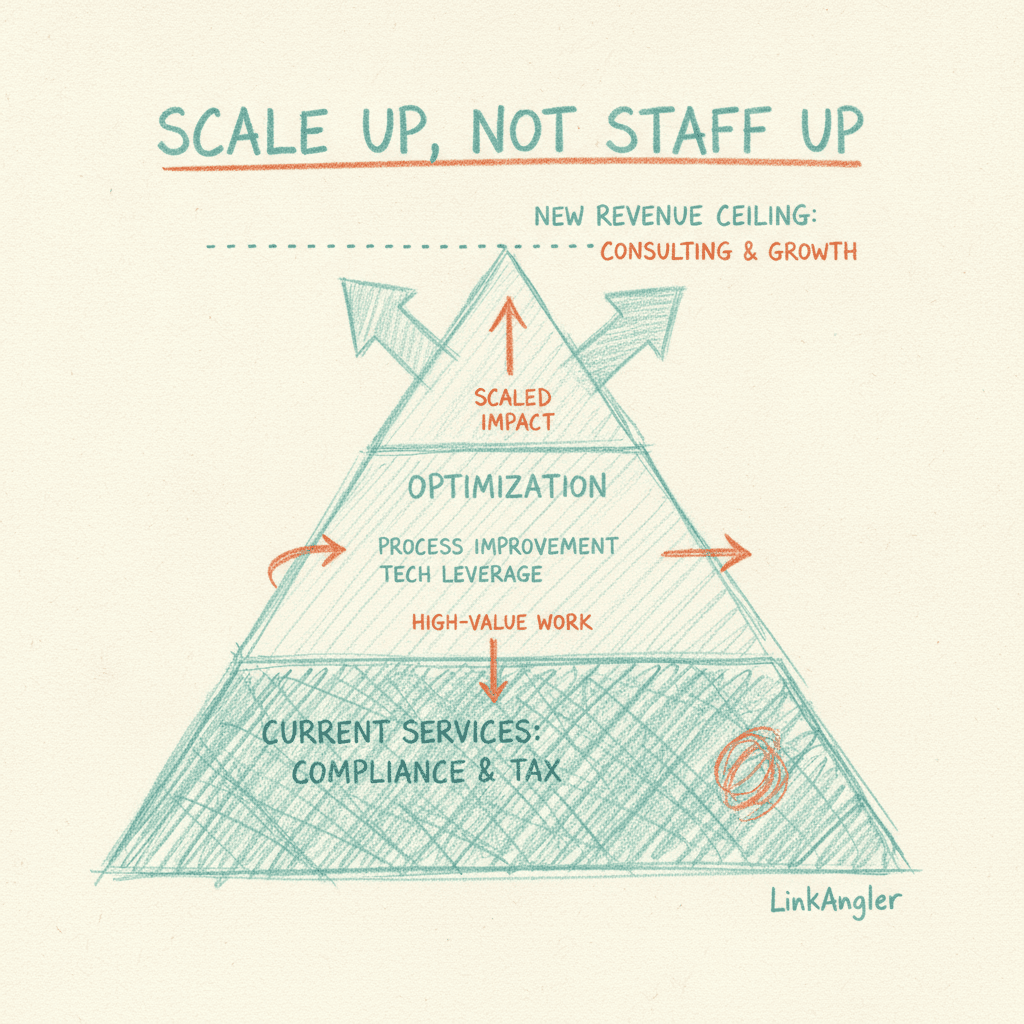
Ask the founder of a growing accountancy practice what is holding revenue back and the answer is rarely "not enough enquiries". More often it is capacity. It is the ability to deliver on the demand already there. Every new client, every fresh engagement, means a cascade of administrative tasks: engagement letters to draft, information requests to send, systems to set up, documents to chase, and internal handoffs to coordinate. All of this must happen before any billable work can even begin.
The partners, the rainmakers, the technical experts, are often maxed out. They are doing the client-facing work, the strategic thinking, and too often, the administrative heavy lifting too. This creates a difficult choice for growth-minded practices: either hire ahead of revenue (a gamble), or quietly start turning work away (a missed opportunity). Neither option truly solves the underlying issue. The problem is not a lack of market demand, but a ceiling imposed by inefficient processes, limiting your accountancy practice capacity.
The Revenue Ceiling is Made of Admin
Consider a professional services firm I worked with. Their situation was clear. Demand for their core services was strong, consistently generating a healthy pipeline of prospective clients. But each new client became a drain on senior resources. The partners and senior managers found themselves pulled into the minutiae of client setup and coordination. They were spending valuable time on tasks that were critical for getting a new client onboarded but were not directly billable.
The bottleneck was not a lack of technical expertise, nor was it insufficient experience within the team. The constraint was the sheer volume of unbilled work wrapped around the billed work. This included all the stages of client intake, the laborious process of onboarding, the constant chasing of documents and information, providing status updates to various stakeholders, and the often-manual assembly required for the monthly reporting cycle. These tasks consumed days, sometimes weeks, of valuable senior time that could have been spent on higher-value client work or strategic practice growth initiatives.
This administrative overhead effectively lowered the real accountancy practice capacity. It meant that even with a strong flow of new business, the practice could not take on as many clients as it could technically service. The internal processes were the limiting factor, not the market or the team's professional capabilities.
What Moving the Ceiling Looked Like
For the particular firm I just mentioned, we went to work on their client intake process. We set out to streamline it end to end. This meant mapping every single step from a signed engagement letter to the point where the client was fully set up and productive work could commence. We identified every point where manual intervention was required, every potential delay, and every instance where a senior person had to be involved in a non-expert capacity.
The transformation was tangible. New clients reached results faster because nothing was left waiting on a partner remembering to send the next request or chase a missing document. Instead, processes were put in place to ensure a smooth, predictable flow. For instance, document chasing became automatic and polite. Automated reminders, triggered by clear checkpoints, were sent out directly to clients or internal teams. This replaced the sporadic, often awkward, manual follow-ups that consumed significant time and mental energy. Clients experienced this consistency as a mark of professionalism.
The critical outcome was that the team stayed focused on high-value delivery. Instead of being bogged down in administrative tasks, senior members could dedicate their time to strategic advice, complex problem-solving, and developing new service lines. This shift significantly increased the practice's ability to serve more clients without needing to add a single new person. The ceiling on their accountancy practice capacity moved upwards, solely by optimising existing resources and processes.
This pattern is not unique to accountancy. The same principles apply across professional services. I saw a similar effect with a coach-led firm we worked with. By rigorously fixing their client setup process alone, they tripled their client capacity. This meant they could serve three times the number of clients with the same core team, translating directly into increased revenue and profitability. Another example came from a B2B sales team that recovered substantial revenue. They did this simply by making their follow-up on warm prospects consistent instead of relying on individual memory. Warm leads were nurtured systematically, ensuring fewer opportunities slipped through the cracks.
Different industries, different services, but the same fundamental lesson: the constraint was never a lack of talent or market opportunity. It was invariably the repetitive, non-billable administrative layer around the core expertise. Address that layer and the ceiling moves, because your accountancy practice capacity was never really about headcount.
Where to Look in Your Own Practice
When you are looking to increase accountancy practice capacity without necessarily hiring, there are three primary areas where you will find the most recoverable hours. These are not always obvious, as they are often deeply embedded in daily routines. But they are rich hunting grounds for efficiency.
1. Client Onboarding
Count the manual touches between a newly signed engagement letter and the point where productive, billable work truly begins. This includes everything from sending the welcome packet, setting up internal project management tools, requesting initial documents, configuring client portals, and scheduling kickoff meetings. Each one of these manual steps represents a potential delay, a moment of friction, and very often, an interruption to a partner or senior manager.
Consider the cumulative impact. If a partner has to personally email five different forms, check if they have been returned, then manually update a spreadsheet, and then initiate follow-up for missing information, that is already a significant time sink. Multiply that by dozens of new clients per year, and the hours rapidly add up.
How to streamline onboarding:
- Automate document collection: Use secure portals or automated systems to request and receive documents. Provide clear instructions and deadlines, with automated reminders if documents are not submitted on time.
- Standardise welcome communications: Create templates for welcome emails, initial information requests, and setup guides. This ensures consistency and reduces drafting time.
- Workflow automation: Map out your onboarding process as a series of steps. Use a workflow tool to trigger each step automatically. For example, once the engagement letter is signed electronically, the system automatically sends the welcome email, creates a client folder, and assigns initial tasks.
- Centralised client data: Ensure client details entered once are accessible across all systems (CRM, accounting software, project management). Avoid repetitive data entry.
By reducing these manual touches, you speed up client activation. Your clients get to work faster. Your team, especially senior members, spends less time on administrative setup and more time on billable, high-value activities. This directly increases your effective accountancy practice capacity.
2. Information Chasing
This is arguably the most automatable work in any professional practice. Requesting information, documents, sign-offs, and scheduling meetings, followed by polite (or perhaps less polite) reminders when those requests go unfulfilled, consumes an enormous amount of time and mental bandwidth. It is classic interrupt work for senior professionals.
Think about the time spent drafting reminder emails, tracking who has or has not responded, and then re-sending requests. This applies to annual accounts information, quarterly VAT details, payroll data, or any other client-provided input crucial for your work. Clients, surprisingly, often experience consistent, automated chasing as a sign of greater professionalism than ad-hoc, manual requests. It shows you are organised and on top of things.
How to streamline chasing:
- Automated reminders: Set up sequences of automated, polite reminders for outstanding information. These can escalate slightly in tone or frequency if initial requests are ignored.
- Client portals with checklists: Give clients a clear portal where they can see exactly what is needed, track their progress, and upload documents. This shifts the burden of tracking to them.
- Templated communications: Beyond reminders, standardise all repeated information requests. Make them easy to understand and respond to.
- Integrate with internal systems: Link your chasing mechanisms to your internal project tracking. So, when a client uploads a document, the status automatically updates, and the next internal task is triggered.
Less time spent chasing means more time spent advising. It frees your team from a tedious, low-value task and improves the client experience through consistent, clear communication. This is a powerful way to boost your accountancy practice capacity.
3. Reporting and Data Assembly
If your month-end or quarter-end client reporting packs are still being assembled by hand from multiple disparate systems, you are likely sacrificing significant senior time. This often involves downloading data from various accounting software, consolidating spreadsheets, reformatting charts, writing narrative summaries, and then combining it all into a polished client-facing document. The time spent on formatting and assembly often far outweighs the time spent on actual analysis and advice.
This issue is particularly prevalent in practices that have grown organically, adding new clients and new software solutions over time, without a unified reporting strategy.
How to streamline reporting:
- Data integration: Explore tools that can pull data automatically from multiple sources into a single dashboard or reporting framework.
- Automated report generation: Utilise software that can generate standard reports with minimal manual intervention. Invest time in setting up templates once.
- Standardised narratives: Develop template narratives for common report sections, allowing for quick customisation rather than writing from scratch every time.
- Client-accessible dashboards: For some clients, providing access to a secure, real-time dashboard can entirely replace periodic report generation, giving them instant access to the information they need.
By automating the assembly line for reporting, senior professionals can spend their valuable time interpreting data, offering strategic insights, and engaging in proactive advisory work, rather than perfecting PowerPoint slides. This significantly enhances your accountancy practice capacity for strategic client engagement.
The Compounding Effect
None of this work is glamorous. Transparently, optimising internal workflows, streamlining document collection, and automating reminders are not the tasks that get celebrated at industry awards. This precisely explains why it creates a compounding advantage. Competitors, focused on visible marketing and sales, often neglect these internal efficiency gains. They will continue to run up against the same capacity ceilings.
A practice that can onboard a new client in days rather than weeks immediately differentiates itself. A practice that never lets a warm prospect go quiet, providing consistent and valuable touchpoints, builds trust. A practice that produces client reporting on demand, with accurate, up-to-date data, shifts the client relationship from reactive to proactive.
This does not just save hours. It creates a fundamentally different client experience. Clients feel they are dealing with a modern, efficient, and professional firm. They receive better service, faster. They get clear communication. This positive feeling translates into stronger client retention, greater client satisfaction, and crucially, more referrals. Word-of-mouth is still the most powerful growth engine for professional services, and positive client experiences fuel that engine.
When you address these operational bottlenecks, you are not just buying back time. You are building a more robust, scalable, and responsive practice. You are investing in a reputation for efficiency and client focus that competitors will find hard to match. This strategic advantage, built on operational excellence, allows you to maximise your accountancy practice capacity and drive significant revenue growth without the immediate pressure of adding new hires.
Pick one of the three. Onboarding, chasing, or reporting, whichever made you wince as you read it. Time how long it actually takes across a month, not how long you think it takes. That number is your ceiling, written down.
Then fix that one thing properly before touching the next. Practices that try to automate everything at once usually end up with three half-built processes and a team that has quietly gone back to doing it by hand.
I build software for the front end of this problem, the part where new work arrives, and the same rule holds there: consistency beats effort, and the practice that never lets a warm enquiry go quiet wins work from firms with better technical reputations. If you want the number before you commit to anything, the free time audit calculator will price your current process in hours per year. It usually lands higher than people expect.