
The Founder Bottleneck: Reclaiming Growth Mode Without Growing Headcount
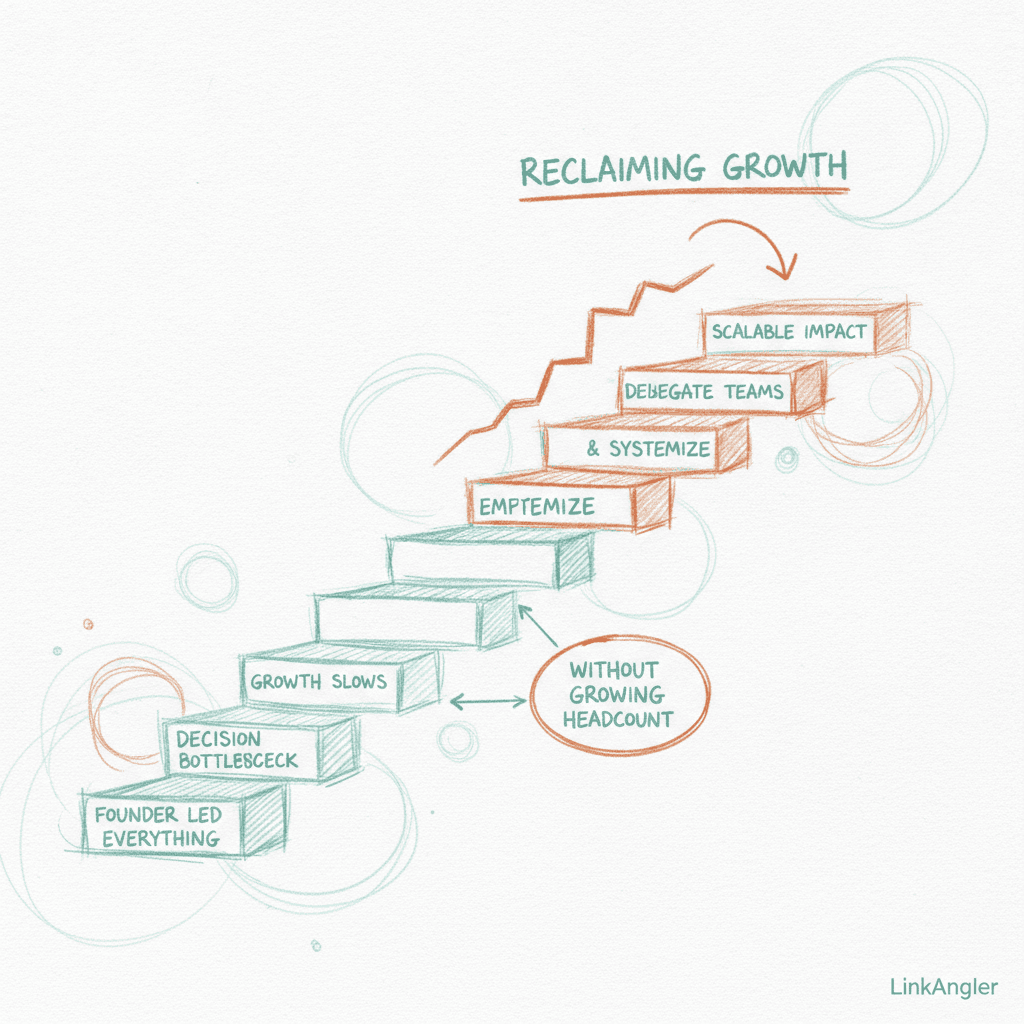
There comes a point in nearly every founder-led business where the founder, often unintentionally, becomes the most significant constraint on growth. This isn't a failure of management. It's a natural accumulation that happens over time. In the early days, you were the fastest path. Every exception, every approval, every "quick question" naturally routed through you. It was efficient then. Now, it means the critical strategic work, the cultivation of key relationships, the development of your next offer, all the things only you can truly do, are quietly pushed aside. They stop happening, or they happen sporadically, always under pressure.
The Diagnostic: Your Calendar Never Lies
The simplest, clearest indicator that you're hitting the founder bottleneck is your calendar. Take a honest look at your week. If it's overflowing with decisions that feel necessary but, when you really think about it, aren't valuable in the grand scheme of things, you're likely caught in this trap. Approvals you merely rubber-stamp, status updates you relay between team members, questions whose answers haven't changed in months, these are all signs.
You are effectively paying a premium salary (your own) for work that, quite frankly, shouldn't exist in its current form or shouldn't require your direct involvement. While you're consumed by these operational fires, the vital growth projects, the strategic initiatives that move the needle, remain on the backburner. They sit there for another month, and then another, slowly eroding your competitive edge and your motivation. This constant state of reaction prevents proactive growth. It grinds down your energy and distracts from the vision you set out to build.
What Removing the Drag Looks Like in Practice
I've seen this exact scenario play out countless times. I worked with a founder once who was precisely in this position. Their days were a non-stop firefighting exercise. Any growth plans were permanently deferred, always secondary to the immediate demands. We didn't wave a magic wand or fundamentally alter their team structure. Instead, we systematically identified and removed the layer of operational drag that had accumulated around them.
Think about it. Repetitive decisions that could be codified, information routing that required a human relay, constant chasing for updates, and coordination tasks that absorbed valuable time. These had all accreted over years, becoming a thick operational sludge that slowed everything down. By offloading these specific tasks, often through smart automation and process streamlining, the results were almost immediate.
Nothing dramatic changed on the organisational chart. But the same team, with the same people, started delivering more work, and doing it faster. Why? Because they were no longer stuck in queues, waiting for the founder's input or approval. Crucially, the founder finally had the mental space and the actual hours in their day to pursue the growth-focused work that had been waiting for months. They transitioned from reacting to building, from managing minutiae to leading strategically. That's the power of addressing the founder bottleneck directly.
Why the Answer is Rarely "Hire Someone"
When founders feel overwhelmed by operational tasks, the natural instinct is often to hire another person, typically an operations manager or an assistant, to absorb the load. Transparently, sometimes that is the right solution. For truly complex, nuanced tasks requiring human judgment and creativity, a dedicated hire is essential.
However, hiring also brings its own set of challenges and demands coordination. It takes months to recruit, onboard, and integrate a new team member effectively. Often, it merely relocates the bottleneck, moving the queue from the founder's desk to someone else's, rather than eliminating the queue altogether. The core problem, the existence of repetitive work, isn't solved, just shifted.
The layer of tasks that often cause the founder bottleneck (approvals based on established rules, status-chasing, reformatting information, relaying messages) is precisely the layer that modern automation now handles exceptionally well. Automated processes don't need coffee breaks, don't get sick, and don't require training beyond their initial setup. My core philosophy, what I built LinkAngler around, is "10 hours to 10 seconds." This principle applies perfectly here. Taking something that consumes a significant amount of your or your team's time each week and condensing it to the time it takes to press a button isn't theoretical. It's achievable.
Removing work entirely always beats simply redistributing it. If a task doesn't need to be done by a human, or doesn't need to be done at all, then it shouldn't be. This approach frees up existing team members for higher-value work, avoids the overheads of new hires, and tackles the root cause of the founder bottleneck.
A Useful Exercise: Diagnosing Your Personal Bottleneck
To truly understand where your time is going, and to effectively address the founder bottleneck, I recommend a simple yet incredibly revealing exercise. For one full week, keep a running log of every single task, request, or decision that comes to your desk. For each item, mark it with one of three categories:
- Only-Me: This task absolutely requires my unique skills, strategic input, or authority. No one else can do this as effectively.
- Someone-Else: This task could and should have been handled by another team member, or it’s a decision that falls within their remit.
- Should-Not-Exist: This task is repetitive, could be automated, is a result of a broken process, or simply adds no value. It shouldn't be routing to anyone, let alone me.
Most founders are genuinely shocked by the size and scope of the "should-not-exist" column. They often find it contains a surprising amount of their weekly burden. This column, the one filled with tasks that add no value and consume your precious time, is the most significant part of your founder bottleneck.
Crucially, it's also often the cheapest and easiest part to clear. You don't need to hire anyone. You don't need to convince existing team members to fundamentally change how they work (though process improvements will naturally follow). The business simply stops routing everything through its most expensive and valuable person (you). By removing these non-value-add tasks, you regain significant bandwidth without incurring additional costs or complicating your team structure.
Practical Steps to Overcome Your Founder Bottleneck
The exercise above is your diagnostic. Now, how do you fix it?
1. Eliminate the "Should-Not-Exist" First
This is your immediate priority. Look for:
- Manual Data Transfers: Are you copying information from one system to another? Can an integration handle this?
- Routine Approvals: If the criteria for approval are always the same, can a simple rule or automated workflow handle it?
- Information Relays: Are you the human email forwarder? Can a shared document, CRM, or communication tool cut you out of the loop?
- Status Chasing: Instead of asking for updates, can you implement shared dashboards or automated reports that keep everyone informed without your intervention?
Often, free or low-cost tools like Zapier, Make (formerly Integromat), or even a deeper dive into your existing software's automation capabilities can eliminate a significant portion of this column. The goal is to remove the work, not just shuffle it. If one of your team members consistently drops the ball on a specific task, don't take it on yourself. Coach them, or reassign it to someone who has the capacity and capability to handle it.
2. Delegate and Empower for "Someone-Else" Tasks
For tasks in the "someone-else" column, the solution is about effective delegation and empowerment.
- Clear Operating Procedures: Document how these tasks should be done. When the process is clear, it's easier for others to follow it without constant questions.
- Training and Mentorship: Invest in your team's skills. If they know how to handle these tasks, they won't need to come to you.
- Defined Decision Matrices: Create frameworks that allow team members to make decisions independently, especially for routine issues. For example, "if a customer asks for X, and conditions Y and Z are met, then proceed with solution A; otherwise, escalate."
- Regular Check-ins, Not Constant Approvals: Shift from approving every step to reviewing outcomes and offering guidance. Trust your team to execute.
This step not only frees your time but also develops your team, giving them more ownership and accountability.
3. Optimise "Only-Me" Tasks
Even the tasks that genuinely require your strategic insight can often be optimised.
- Batching Similar Tasks: Instead of context-switching constantly, set aside specific blocks of time for strategic thinking, client calls, or creative work.
- Focused Work Environments: Eliminate distractions during these crucial "Only-Me" blocks. Turn off notifications, close unnecessary tabs.
- Pre-work and Post-work: Can your team prepare a concise briefing for you before a strategic meeting? Can they take detailed notes and actions afterward, so you just review and refine?
These small changes can dramatically improve your efficiency on tasks that matter most, making sure your expensive "Only-Me" time is spent on productive work, not administrative overhead.
The Link Between Bandwidth and Growth
The founder bottleneck isn't just about feeling busy. It's about a concrete lack of bandwidth impacting your business's ability to grow. You can't cultivate new client relationships, explore new markets, or innovate new offerings if your energy is drained by daily operational minutiae.
Consider the core activity of bringing in new business. Finding ideal clients, crafting compelling outreach, initiating conversations, following up with interested parties, and converting those into booked sales calls. For many founders, this eats up easily 10 hours a week, often more. If just one booked call turns into a client that brings in 1,000 pounds or more per month, the return on solving this specific bottleneck is immense. Yet, this is precisely the kind of repetitive, time-consuming effort that often falls into the "should-not-exist" or "someone-else" columns for a founder.
This is where smart automation becomes indispensable. Instead of spending your precious time digging through LinkedIn, crafting individual messages, and sending manual follow-ups, imagine setting up a system that handles this for you. Your calendar could fill itself with qualified prospects, leaving you free to focus on closing deals and strategic growth. When you're consistently booking sales calls on autopilot, you reclaim that 10 hours a week, transforming it into seconds it takes to review outcomes or make a strategic tweak.
LinkAngler was built to solve precisely these kinds of challenges, delivering booked calls on autopilot so that finding new clients becomes a solved problem, not a recurring bottleneck. It ensures that critical growth activities, like pipeline generation, continue to run effectively without consuming your personal bandwidth.
Growth mode is not some inherent personality trait you lost along the way. It's a bandwidth problem, pure and simple. And the good news is, bandwidth can be engineered back into your day, into your week, and into your business. By systematically addressing the founder bottleneck, you not only reclaim your time and energy but also put your business back on a sustainable growth trajectory. If you're wondering just how much time you're truly losing to these tasks, check out our free time audit calculator. It might just shock you into action.