
The LinkedIn Automation Audit: Fix These Mistakes With LinkAngler
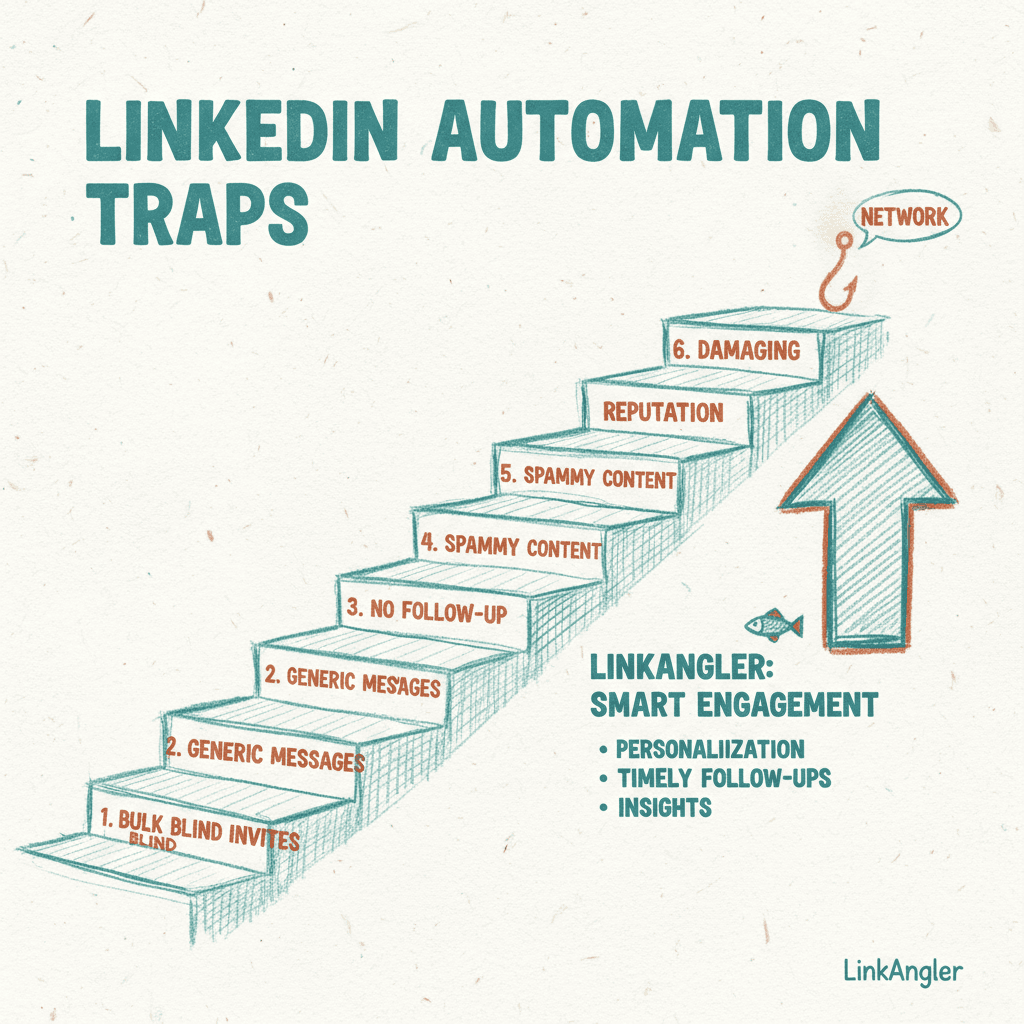
Most people set up their LinkedIn automation, let it run, and then wonder why their inbox is full of angry replies or — worse — complete silence.
Here's the thing: the tool you're using rarely is the problem. It's almost always how you're using it. Bad targeting, lazy messaging, zero follow-through, and a complete lack of personalisation will tank your results no matter how sophisticated your stack is.
This isn't another "avoid spamming people" article. What follows is a proper audit framework — a way to look at every layer of your LinkedIn automation setup and identify exactly where things are going wrong. And yes, where LinkAngler can genuinely help you fix it.
Start With the Audit Mentality
Before you touch a single setting, shift your mindset. Most LinkedIn automation problems are diagnostic problems — people are tweaking the wrong things because they haven't properly identified what's broken.
Think of your outreach as a funnel with distinct stages:
- Who you're targeting (ICP and lead quality)
- How you're reaching out (connection request quality)
- What you're saying (message content and sequencing)
- How you're following up (timing, channel variety, persistence)
- What happens when they engage (conversion to meeting or reply)
Most audits people do only look at stage 3. That's why they keep rewriting messages and seeing no improvement — the problem is actually upstream.
Mistake #1: Your ICP Is Too Vague (Or Wrong Entirely)
This is the single biggest driver of poor LinkedIn automation results, and almost nobody talks about it because it feels like an obvious thing to have figured out.
But ask yourself honestly: are you targeting "marketing managers at B2B SaaS companies" because that's genuinely your best customer, or because that's who you think your best customer is?
The fix: Go back to your actual closed-won deals from the last 12 months. Look for patterns — job titles, company sizes, industries, the specific problems they mentioned before signing. That's your real ICP.
Once you have that, build your targeting around it ruthlessly. Narrow is almost always better. A campaign targeting "Head of Revenue Operations at Series B SaaS companies with 50-200 employees" will outperform "Sales Directors at tech companies" every single time.
LinkAngler's AI Lead Discovery can accelerate this process by scanning LinkedIn and surfacing leads that match your ICP criteria, but it's only as good as the ICP you feed it. Garbage in, garbage out.
The platform also gives every lead an ICP lead score from 0-100, which means instead of manually vetting hundreds of profiles, you can prioritise the ones most likely to convert. That said — spend time defining your ICP properly first. The scoring amplifies good input; it doesn't replace it.
Mistake #2: Treating Your Connection Request Like a Cold Call
Your connection request is not a sales pitch. Full stop.
The number of people using LinkedIn automation to fire off connection requests with walls of text explaining what they do and asking for 15 minutes is frankly staggering. And it doesn't work — LinkedIn users have become immune to it.
Your connection request has one job: to be compelling enough that someone wants to know more about you.
Think of it like the subject line of an email. It doesn't need to close the deal. It needs to open the door.
What works:
- Reference something genuinely specific (a post they wrote, a mutual connection, a shared experience)
- Lead with curiosity rather than pitching
- Be shorter than you think you need to be
What doesn't work:
- Generic flattery ("I love your work!")
- Immediately explaining your product
- Asking for time before they've even accepted
If you're running automated connection requests at scale, the temptation is to use one template for everyone. Resist it. Even small personalisation tokens — company name, recent role change, shared group — measurably improve acceptance rates.
Mistake #3: Your Follow-Up Sequence Falls Off a Cliff
Someone accepts your connection request. You send a message. They don't reply. What do you do?
Most people either send nothing or send the same message again with "just following up" tacked on the front. Both are mistakes.
A solid follow-up sequence should feel like a conversation thread, not a series of independent cold emails. Each message should build on the last, offer something slightly different, and give the recipient a reason to engage this time even if they didn't last time.
Here's a framework that works:
- Message 1: Warm intro, light value add, no ask
- Message 2 (3-5 days later): Relevant insight or resource, soft ask
- Message 3 (5-7 days later): Direct ask — clear, brief, easy to respond to
- Message 4 (optional, 7+ days later): The break-up email — honest, zero pressure
The magic is in the spacing and the tone shift across the sequence. You're not nagging — you're building familiarity.
LinkAngler's multi-step campaign automation lets you build sequences exactly like this, including adding delays between steps and mixing in different types of touchpoints (messages, post engagement, voice notes). That variety is what separates a campaign that feels like spam from one that feels like genuine outreach.
Mistake #4: You're Only Using Text
Here's something most LinkedIn automation users haven't fully wrapped their heads around yet: the medium is part of the message.
When everyone is sending text messages, sending a voice note or a personalised video makes you memorable by default. It's not a gimmick — it's signal differentiation.
And yes, doing this at scale used to be impossible. But that's changed.
LinkAngler's voice note outreach uses AI text-to-speech (via ElevenLabs) with voice cloning, so you can send what sounds like a personally recorded voice message to hundreds of leads without recording hundreds of audio clips. You write the script, the AI delivers it in your voice.
On the video side, you can record a single base video and have personalised, AI lip-synced versions generated for each prospect — using their name, company, or whatever context is relevant. These get delivered via video landing pages that auto-play, show a preview when you share the link, and include a booking CTA so the path from "I just watched your video" to "I booked a call" is as frictionless as possible.
None of this replaces good messaging — it amplifies it. If your copy is weak, a video won't save you. But if you've already nailed your messaging and you want to stand out, this is the lever most of your competitors haven't pulled yet.
Mistake #5: Ignoring Engagement Signals
Most LinkedIn automation setups are one-directional — you send messages, you wait. But LinkedIn gives you a ton of behavioural data if you're paying attention.
Who's viewing your profile after you connect? Who's liking your posts? Who's commenting on content in your space? These are warm signals, and treating them the same as cold leads is a massive missed opportunity.
Hot leads — people who've already shown some level of interest — convert at dramatically higher rates than cold ones. Prioritising your follow-up around engagement signals rather than just "days since last message" is one of the highest-leverage changes you can make to any outreach sequence.
LinkAngler surfaces these signals through hot lead detection, flagging prospects who are engaging with your content or profile so you can prioritise your outreach accordingly. Instead of playing the numbers game with cold volume, you're focusing effort where there's already some warmth.
Mistake #6: You're Not Looking at the Right Metrics
If you're only measuring reply rate, you're flying blind.
Reply rate is a useful metric, but it's a lagging indicator — by the time you see it dropping, the problem has already been happening for a while. You need to be watching the full funnel:
- Connection acceptance rate — if this is low, your request message or targeting is off
- Reply rate on message 1 — if this is low, your opening message isn't landing
- Reply rate on follow-ups — if replies only come after message 3 or 4, you might need a more direct opener
- Positive reply rate — not just replies, but replies that aren't "no thanks" or worse
- Meeting booked rate — how many conversations actually convert to calendar slots
Map these metrics to specific stages in your sequence, and suddenly you can actually identify where the breakdown is happening instead of just rewriting everything from scratch.
LinkAngler's campaign analytics breaks performance down by step in your sequence, so you can see exactly where people are dropping off. It's the difference between guessing and knowing.
Mistake #7: Running Campaigns and Walking Away
LinkedIn automation doesn't run itself — or rather, it can, but the best results come from people who treat their campaigns as living things that need regular attention.
A weekly audit habit that takes 20 minutes:
- Check acceptance rates on active campaigns — anything below 25% needs attention
- Read through your recent replies — even the negative ones tell you something
- Look at which step has the lowest continuation rate and rewrite that message
- Check if any leads flagged as hot have gone cold (and if so, why)
- Review any video or voice note engagement metrics
This isn't about micromanaging your automation — it's about staying close enough to the data that you catch problems early instead of letting bad campaigns run for weeks.
Putting It All Together
Run through this checklist the next time you're evaluating your LinkedIn automation setup:
- [ ] Is my ICP defined by actual customer data, not assumptions?
- [ ] Are my connection requests short, specific, and non-pitchy?
- [ ] Does my follow-up sequence build progressively, not just repeat?
- [ ] Am I using more than one medium (text, voice, video)?
- [ ] Am I prioritising warm and engaged leads over cold volume?
- [ ] Am I tracking metrics at each stage of the funnel, not just overall reply rate?
- [ ] Am I reviewing and adjusting campaigns at least weekly?
If you can check all seven boxes, you're in a genuinely small minority of LinkedIn automation users — and your results will reflect that.
Final Thought
The best LinkedIn automation setup in the world is just a system for delivering your thinking at scale. If your targeting is sloppy, your messaging is generic, and you're not paying attention to the data, automation just lets you make mistakes faster.
But when you get the fundamentals right — tight ICP, sharp messaging, varied touchpoints, and a habit of actually reviewing performance — automation becomes a genuine growth lever. That's what LinkAngler is built to support: not just sending more messages, but building campaigns that are actually worth sending.
Start with the audit. Fix what's broken. Then scale what works.