
The Story Is the Bridge: Storytelling for Coaches Working With Sensitive Topics
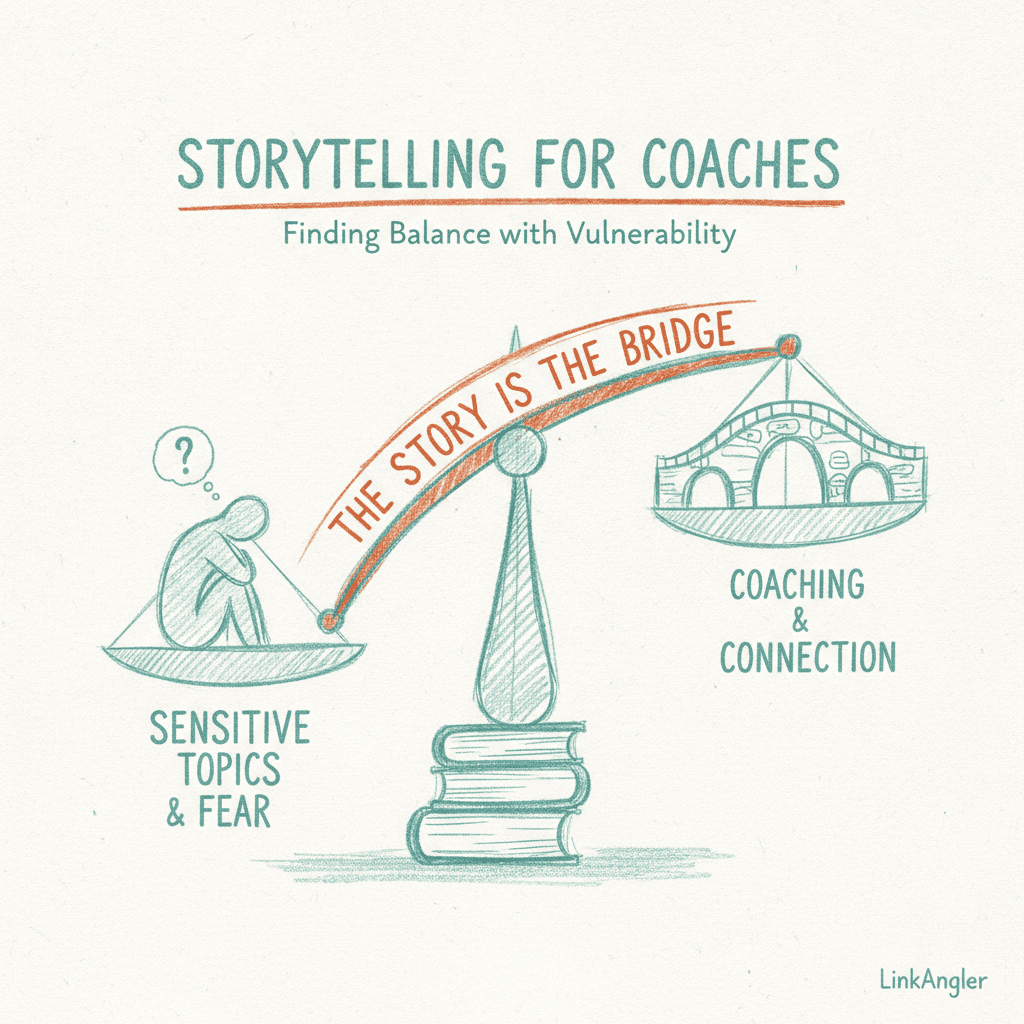
When you work with grief, trauma, or serious illness, your audience lives behind a natural guard. This is for very good reasons. They are protecting themselves. Direct advice, no matter how profoundly wise it may be, often lands as a demand. It says, "Believe me, do this, change." That can feel pushy, even invasive, when someone is already vulnerable.
A story, however, makes no such demand. It simply presents an experience. It says, "This happened, and someone found their way through it." It acts as a mirror, not a command. The listener is then given the space to recognise elements of their own journey within that narrative. They do this privately, at their own pace, without feeling exposed or judged. This quiet moment of self-recognition, that internal "that is me", is where true engagement begins. It is the moment their guard drops, just a little, allowing a connection to form.
Three Rules for Safe Storytelling
Storytelling for coaches, especially in sensitive areas, requires careful navigation. Your goal is to build trust, not exploit vulnerability. These three rules act as your compass, ensuring your stories serve your audience safely and ethically.
Tell Scars, Not Wounds
This is perhaps the most crucial rule for anyone sharing personal narratives in a professional context. Share what you have processed, not what is still bleeding. A scar is a testament to healing, a journey completed, a lesson learned. It shows resilience. Your audience can lean on a scar. They can see themselves in the journey of recovery. They can draw strength from your past navigation of difficulty.
A wound, however, is active and raw. It demands attention. When you share an unhealed wound, you inadvertently put the burden on your audience to care for you. This flips the dynamic of a coaching relationship, which should always position you as the stable, supportive guide.
Think about the difference. A scar might be, "After losing my own mother, I spent years in a fog, but eventually, I learned how to honour her memory without letting grief consume my present." This shows a path through. A wound might be, "I am still in the middle of this, and some mornings I cannot get out of bed." Vulnerability matters, but raw, unprocessed pain is not yours to hand to an audience. It makes them worry about you, rather than focusing on their own journey.
Ask yourself: Does this story demonstrate my capacity to navigate tough situations and emerge stronger? Or does it expose an ongoing struggle that might make my audience question my ability to support them?
One Story, One Shift
The power of a good story in coaching lies in its clarity. Each story should carry a single, distinct change. This means focusing on a specific journey: what was believed before, what happened to challenge or change that belief, and what is believed now.
Resist the temptation to teach three lessons at once. When you try to pack too much into a single narrative, the message becomes diluted. Your audience will struggle to follow the thread, and the impact of your story will be lost.
Consider an example. Instead of trying to cover resilience, self-compassion, and financial stability all in one story about overcoming a business downturn, pick one. For instance:
- Before: "I always thought my worth was tied to my productivity."
- Happened: "Then a serious illness forced me to stop working for months."
- Now: "I discovered I am worthy simply by existing, and my productivity actually improved when I focused on rest."
This structure provides a clear arc. It makes the story digestible and the lesson memorable. Your audience can easily grasp the transformation and consider how a similar shift might apply to their own lives.
Guard Your Clients Fiercely
Your ethics are paramount, especially when working with sensitive topics. Every story you tell should prove it is safe to be your client. Confidentiality is non-negotiable.
This means you must be diligent about anything that could identify someone. Change names without fail. Blur details that could point to a specific person: instead of "my client, Sarah, a 45-year-old artist from Brighton who lost her sister in a car accident last November," you might say, "a client navigating profound loss after the sudden death of a loved one."
Merge situations where necessary. You might combine an insight from one client's experience with a challenge faced by another to create a composite narrative that serves the point without revealing either individual. Another option, and one that requires careful consideration, is to ask for explicit consent. If a client has had a particularly transformative experience and explicitly agrees for you to share some details (perhaps even reviewing what you write), that can work. However, always default to anonymisation and blurring.
The moment a potential client fears their darkest moments might become fodder for your content, you have broken trust. Your storytelling should reinforce, not undermine, the absolute safety and privacy of your coaching space.
Consistency Beats Intensity
Many coaches I know have incredibly rich experiences, full of powerful stories. Yet, turning those into content often becomes another item on a never-ending to-do list. An executive coach I worked with, for instance, had powerful insights from her sessions. She knew her stories resonated. But the process of crafting and publishing them into posts and newsletters was eating roughly ten hours a week. This made it unsustainable.
What happened? She fell into the "feast or famine" cycle. She would publish intensely for a fortnight, full of enthusiasm, then vanish for a month or more, overwhelmed by other demands. Her audience, dealing with complex personal challenges, needed a consistent presence, a gentle reminder that she was there. They needed reliability.
Once her stories started going out consistently, without that exhausting ten-hour weekly cost, something remarkable happened. Her inbound enquiries doubled. Nothing about her core expertise or her coaching methodology changed. Her stories became a constant hum in the background, a steady light. People simply heard from her often enough to trust that she would still be there when they were genuinely ready to reach out.
In deeply sensitive work, this matters doubly. Someone grappling with grief, for example, might follow you silently for six months, consuming your stories, before they feel ready to send that first message. They are not looking for a quick fix. They are looking for a guide they can trust to walk with them when the time is right. A consistent presence signals that reliability.
Finding a rhythm you can hold for a year, not just a fortnight, is the whole game. Which means the honest question is not "what should I write?" but "what can I still be doing in March?"
Engagement Deepens in the Follow-Through
A compelling story opens a door. But a good story alone does not always translate into booked calls. I observed another coach sitting on a warm pipeline that was quietly going cold. People engaged deeply with her stories. They commented, they shared, they even sent initial enquiry messages. Then, life moved on for them. The spark dimmed.
The problem was not the quality of her stories, but what happened (or did not happen) after the story. Her follow-through was inconsistent. It was either absent or felt like a clumsy "just checking in" message, which carries a whiff of transactional urgency rather than genuine care.
When her follow-through became consistent, acting as gentle continuations of the same conversation her stories started, everything shifted. These were not generic pushes for a call. They were thoughtful responses, further reflections, or additional resources that genuinely extended the dialogue. She wasn't chasing. She was nurturing.
The result? She booked 40% more discovery calls from exactly the same pool of interested people. The story opens the door; the gentle, consistent follow-through walks through it. This approach respects the emotional space of someone considering sensitive work. It mirrors the pacing and empathy they would expect in a coaching relationship.
This can look like a gentle weekly email that builds on a past story, or a thoughtful reply to a comment that continues the thread of insight. Present, but not pushy. The practical version is simply this: when someone engages, write the next line of the same conversation, not the first line of a sales one.
Clear Stories Find the Right Clients
Everyone knows the frustration of a discovery call that was never going to be a fit. It drains your energy and your time, and leaves both people faintly disappointed. A third coach I worked with found a powerful lever here. She did not change her coaching offer, her pricing, or her core methodology. Instead, she sharpened her storytelling.
When her stories began to clearly articulate who they were for, it transformed her business. Her narratives started painting vivid pictures of the client she serves, their specific struggles, and the unique kind of transformation they seek. These stories resonated deeply with the right people and quietly repelled the wrong ones.
The outcome? She doubled her close rate. Without a single change to her sales script or her coaching programme, she was closing more deals because the people showing up for discovery calls were already pre-qualified by her stories. They had already deeply connected with the narrative. They understood the journey she guided people through. They arrived with a baseline of trust and recognition.
For deeply personal work like grief or trauma coaching, this is invaluable. It protects your energy for the people you can genuinely help. Wrong-fit conversations quietly fall away before they ever reach your diary, and the ones that remain start from trust rather than from scratch.
A Simple Weekly Practice
The idea of consistent, impactful storytelling does not need to be a massive undertaking. In fact, it often comes down to a small, repeatable practice. Here is a simple framework for storytelling for coaches that you can integrate into your week:
Once a week, schedule 20 minutes to record a voice note. In this recording, focus on three things:
- One client moment: Recall a general, anonymised situation where a client experienced a shift or voiced a profound insight. Remember to protect confidentiality fiercely. Change all identifying details. The essence of the moment is what matters, not the specifics of the individual.
- One thing it taught you: What overarching lesson or understanding did you gain from this client's journey? This is your "scar," your processed wisdom. Frame it as a universal principle or a different perspective you now hold.
- One question you keep hearing: What common struggle or query arises repeatedly in your conversations or within your community? This shows you understand your audience's concerns.
Now, take that 20-minute voice note and distill it. Your goal is to trim it down to a single shift in understanding. What was the old way of thinking, what initiated the change, and what is the new perspective? This adheres to the "one story, one shift" rule.
Finally, end your story with a gentle invitation. This should be a question, not a pitch. Something that encourages reflection or further conversation. For example: "Where in your life might a similar pivot be waiting?" or "Have you ever found yourself wrestling with a similar question?" This sparks engagement without feeling aggressive.
Publish this story on a rhythm you can genuinely hold for a year, not just a fortnight. Consistency, remember, beats intensity. Whether it is a weekly blog post, a short email, or a LinkedIn update, commit to a schedule that is realistic for you.
When someone engages with your story, continue that conversation personally. This goes back to the importance of follow-through. Respond thoughtfully to comments. Engage with replies to your emails. Your goal is to move from a general broadcast to a one-on-one dialogue. This is where readers become real clients.
None of the three coaches above changed what they knew. They changed how reliably it reached anyone.
Transparently, the ten hours is the part I could not solve by trying harder, which is why I ended up building LinkAngler. One voice note becomes a week of drafts in your own voice, and nothing publishes until you have read it, because on this subject matter a machine should never get the last word. If that is the bit stopping you, the build-it-yourself guide is free, prompt included, and you are welcome to it whether or not you ever speak to me.
But the practice is the point, and the practice costs nothing. Record twenty minutes this week about the question your clients keep asking. Trim it to one shift. Publish it on a rhythm you can hold in March, and answer the people who reply.
That is the bridge. Your job is just to keep walking across it.