
Why Video & Voice Outreach Gets More LinkedIn Replies (With LinkAngler)
Let's be honest. Your LinkedIn inbox is a graveyard of unread "just wanted to connect" messages and generic "I'd love to chat about synergies" follow-ups. Everyone's sending them. Nobody's reading them.
So if you're wondering why your outreach isn't converting — despite having a solid offer, a decent headline, and a polished profile — the problem probably isn't your targeting. It's your format.
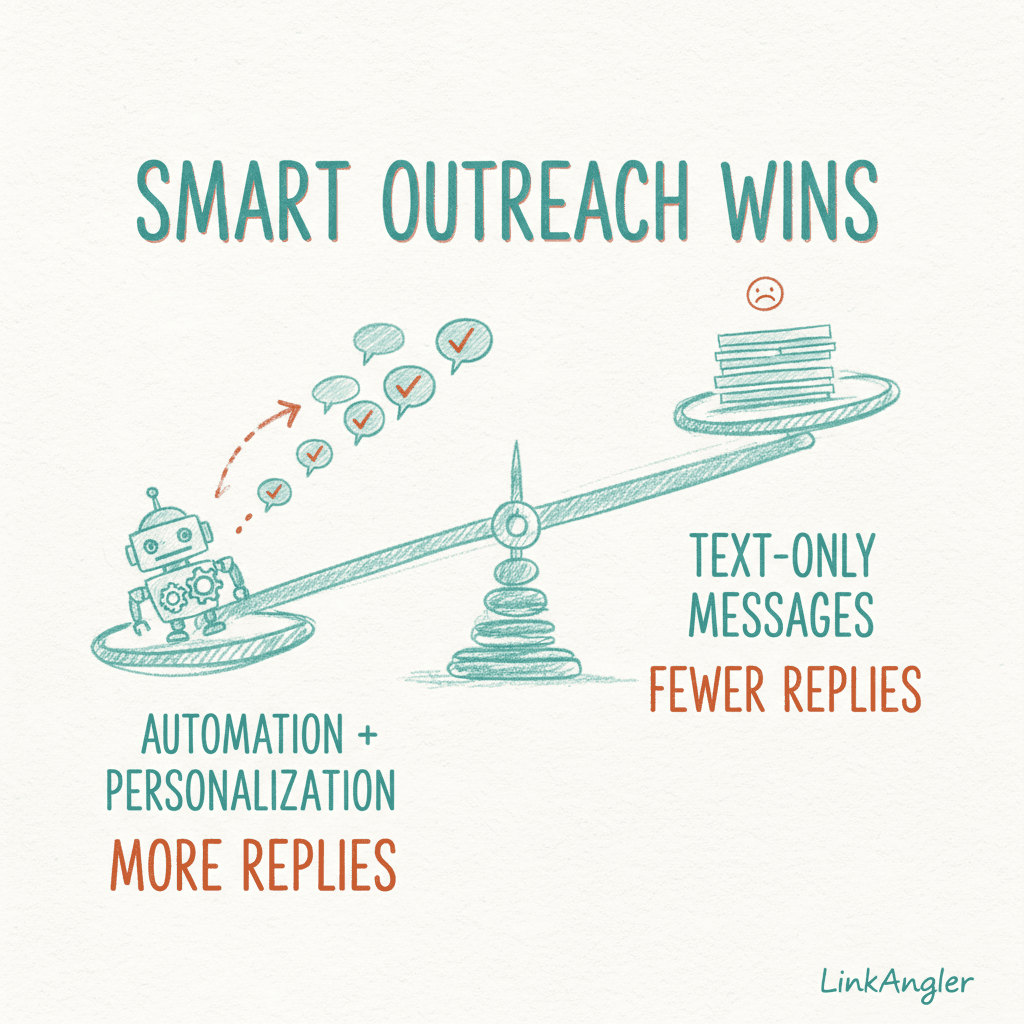
Text-only messages have hit a wall. They're easy to ignore, easy to forget, and increasingly indistinguishable from spam. The people who are winning at LinkedIn outreach right now are doing something different: they're using video and voice to cut through the noise in a way that plain text simply can't match.
Here's why the format shift matters more than most people realise — and how to actually execute it without spending your entire day recording personalised videos one by one.
Why Text Messages Feel Disposable
Think about how you personally experience LinkedIn messages. Someone lands in your inbox. You skim the first line. If it doesn't immediately grab you, you scroll past and mentally file it under "deal with later" — which usually means never.
That's not because people are rude. It's because text is cognitively cheap to process and easy to dismiss. Your brain can scan a paragraph in two seconds, decide it's not urgent, and move on without guilt.
Video and voice work differently. There's a psychological mechanism called the "commitment effect" — once you click play, you feel a pull to finish what you started. A 30-second voice note feels like a conversation that deserves a response in a way that a paragraph of text simply doesn't.
Beyond psychology, there's the simple reality of differentiation. If 95% of LinkedIn messages are text, showing up with a personalised video or voice note immediately signals that you've put in effort. Effort implies intent. Intent implies value. And that's before the prospect has even heard what you're saying.
The Data Behind Video and Voice Outreach
You don't have to take this on faith. The shift toward richer media in B2B outreach is well-documented:
- Video messages on LinkedIn generate 3x higher response rates than text messages in most outreach campaigns (Vidyard, 2023 State of Video Report)
- Voice notes have a listen-through rate significantly higher than open rates on text messages — because once someone taps play, they tend to listen
- Personalised video thumbnails in email outreach (a closely related format) have been shown to increase CTR by over 96% (HubSpot)
The underlying principle is the same across formats: humans respond to humans. And nothing signals "human" quite like a voice or a face.
What Makes a Great Video or Voice Outreach Message
Before we get into the automation side, let's talk about what actually works — because a mediocre video at scale is still a mediocre video.
Keep it short and specific
The biggest mistake people make with video outreach? Treating it like a pitch deck. Nobody wants to watch a four-minute product demo from a stranger.
The sweet spot for LinkedIn video messages is 30–90 seconds. Use that time to:
- Address them by name and reference something specific (their post, a mutual connection, their company news)
- State one clear reason you're reaching out
- Ask one simple, low-commitment question
That's it. You're not closing a deal in a video message. You're starting a conversation.
Make the personalisation visible immediately
The thumbnail matters enormously. If your video thumbnail shows a whiteboard with their company name on it, or you're holding up a screenshot of their LinkedIn profile, they'll click almost every time. The personalisation has to be obvious before they even press play.
Match your energy to their vibe
If someone's LinkedIn presence is warm and casual, mirror that. If they're a serious enterprise executive, dial back the enthusiasm. Tone-matching is a form of personalisation that most people overlook.
The Scaling Problem (And How to Solve It)
Here's the objection I hear every time this topic comes up: "That sounds great, but I can't record 50 personalised videos a day."
Fair point. And that's exactly where LinkedIn automation changes the game.
The challenge with video and voice outreach has always been the time-to-volume ratio. Recording a genuinely personalised video for each prospect takes 5–10 minutes per person. At any kind of scale, that's a full-time job. Which is why most people give up and fall back on text templates.
But the technology has caught up. You can now generate personalised video and voice messages at scale — and we're not talking about obvious, robotic AI content. We're talking about something that actually feels human.
How LinkAngler Approaches This
LinkAngler was built around the idea that outreach should feel personal, even when it's automated. Here's how it handles the video and voice challenge specifically:
AI-Powered Voice Notes
Using ElevenLabs' voice synthesis technology, LinkAngler can generate personalised voice notes that sound natural — including cloning your own voice. So instead of recording a new message for every prospect, you write a personalised script, and your AI voice delivers it.
This means you can send voice outreach at scale that actually sounds like you — not a generic text-to-speech robot. You can check out the voice note outreach feature to see how it works in practice.
Personalised Video at Scale
This is where it gets genuinely interesting. LinkAngler integrates with fal.ai's lip-sync technology to let you record one master video and then generate personalised variations for each prospect — where the video shows you appearing to say their name, reference their company, or acknowledge something specific to them.
The result is a video message that feels handcrafted, even when it's been generated at scale. Prospects don't know the difference. They just know that someone took the time to record a video specifically for them. Explore the full video messaging capabilities if you want to see what's possible.
Video Landing Pages with Tracking
Sending a video is only half the story. LinkAngler also lets you host those videos on branded landing pages with auto-play, Open Graph previews (so the video thumbnail shows up beautifully when you drop the link in a LinkedIn message), view tracking, and built-in CTAs like Calendly or Cal.com booking links.
That means you can see exactly who watched your video, how long they watched, and whether they booked a call — all without chasing anyone for a response.
Building a Multi-Format Outreach Sequence
The real power comes from combining formats strategically within a campaign. Here's a sequence that works well:
Step 1: Connection Request (Text, Short)
Keep it human, keep it brief. Reference something real. No pitch.
"Hey [Name] — saw your post on [topic], really resonated. Would love to connect."
Step 2: Voice Note (Day 2–3 After Connecting)
This is your pattern interrupt. Record a 30–45 second voice note or generate one using AI voice cloning. Keep it conversational:
"Hey [Name], thanks for connecting! I noticed you're working on [specific thing]. We've been helping [relevant companies] with [specific outcome] — thought it might be worth a quick chat. No pressure at all, just figured I'd reach out the human way."
Step 3: Personalised Video Message (Day 5–7)
This is your main value delivery. Send the video link with a brief text intro:
"Recorded a quick 60-second video for you — thought it'd be easier than typing everything out."
The video should reference their specific situation and end with a clear, low-stakes CTA (a question, not a pitch).
Step 4: Text Follow-Up (Day 10–12)
A simple, light-touch follow-up. Something like:
"Just wanted to bump this in case it got buried — happy to share a few thoughts on [topic] if it's useful."
This sequence, when built as a multi-step campaign with proper delays and conditions, typically outperforms any single-channel approach by a significant margin.
Common Mistakes to Avoid
Even with great tools, there are ways to get this wrong. Watch out for:
Using video as a pitch vehicle Your first video message should open a conversation, not close a sale. If you're screen-recording a product demo, you've already lost them.
Forgetting the thumbnail A video link without a compelling thumbnail is just a link. Make sure your Open Graph preview or landing page thumbnail shows something that makes them want to click — ideally something that signals personalisation.
Ignoring the follow-up Most replies come after the second or third touchpoint. Don't send one video and give up. The sequence matters.
Sending to the wrong people Rich media outreach is worth more per message, so make sure you're spending it on the right prospects. This is where AI-powered lead scoring pays for itself — knowing which leads are a genuine fit before you invest in personalised outreach.
Making it too polished Counterintuitively, over-produced videos can feel less authentic. A slightly imperfect, genuine-sounding video message often outperforms a slick, branded production. Aim for real, not perfect.
Why This Matters for Your LinkedIn Automation Strategy
The evolution of LinkedIn automation isn't just about sending more messages faster. That era — blast-and-hope, connection-request spam, generic follow-up sequences — is largely over. LinkedIn's algorithm and its users have both gotten better at filtering it out.
The next era is about quality signals at scale. It's about using automation to deliver outreach that feels like it couldn't be automated — and video and voice are the clearest expression of that shift.
If you're investing time and budget into LinkedIn automation without experimenting with richer formats, you're leaving a significant amount of response rate on the table. Not because text doesn't work at all, but because video and voice work measurably better — and the tools to do it at scale now exist.
For a closer look at how teams are using these formats across different use cases, the founders use case page and sales teams are worth a browse.
Quick Recap
- Text-only messages are easy to ignore — psychologically and practically
- Video and voice trigger a response instinct that text simply doesn't
- Personalisation is the key ingredient — visible before they even click play
- Scaling personalised video and voice is now possible with AI voice cloning and lip-sync technology
- The best outreach sequences combine formats — connection request → voice note → video → text follow-up
- Tools like LinkAngler handle the heavy lifting of multi-step campaign automation while keeping the outreach feeling human
The people winning on LinkedIn right now aren't necessarily working harder. They're just showing up in a way that's harder to ignore.